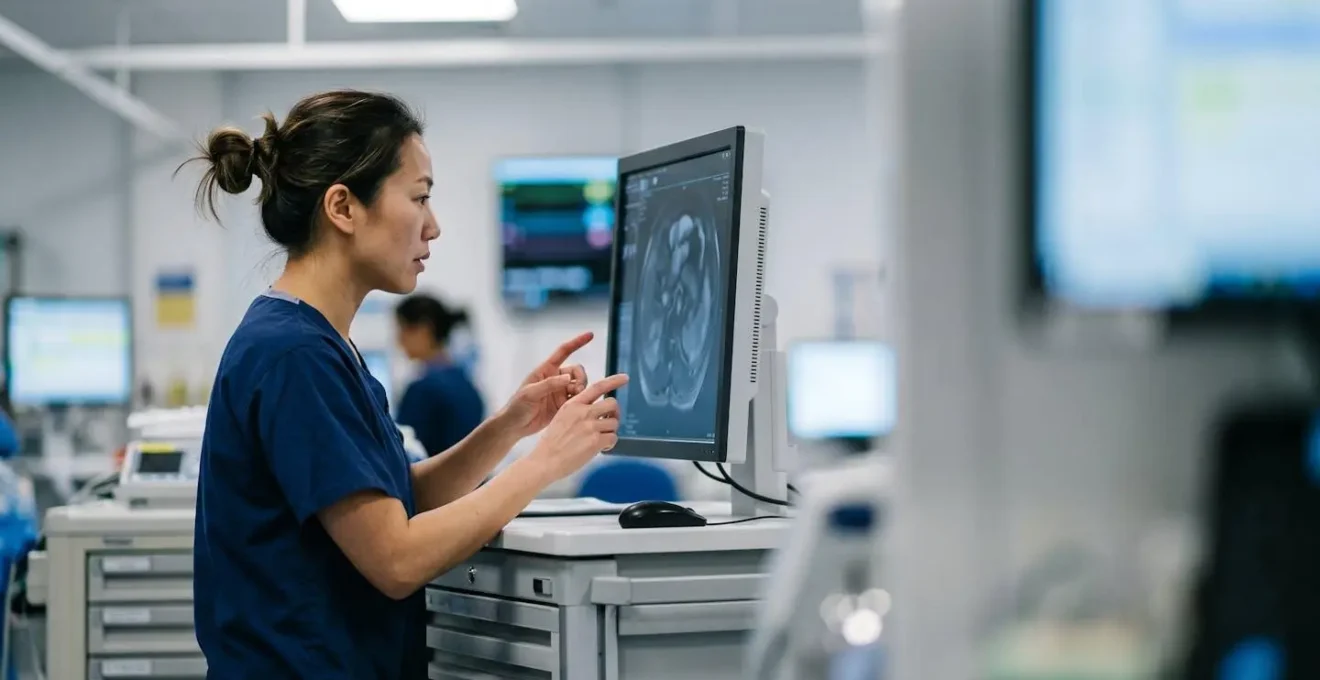
Many believe the rise of AI in healthcare is a battle between human doctors and machines. The reality is far more hopeful: it’s about creating an expert partnership.
- AI excels at spotting patterns humans miss and automating admin, freeing doctors for patient care.
- However, it’s vulnerable to data bias and lacks human context, requiring constant clinical oversight.
Recommendation: Trust the clinician, who uses AI as a powerful tool, not as a replacement for their own judgment.
The thought of a computer algorithm holding sway over your health can be unsettling. As a patient, your greatest fear is that your symptoms, the subtle clues you know are important, might be dismissed by a cold, unfeeling system. You might wonder: « What if the machine misses something? Can I really trust an AI with my diagnosis? » These are not just valid concerns; they are the most important questions we face as we integrate these powerful new technologies into the NHS.
The conversation is often dominated by extremes. On one hand, there’s the promise of flawless, instant diagnoses. On the other, the fear of rogue algorithms and job-stealing robots. The truth, as is often the case in medicine, is more nuanced and, frankly, more reassuring. The goal isn’t to replace doctors with AI, but to create an ‘augmented clinician’—a human expert whose skills are amplified by an incredibly powerful co-pilot.
This article moves beyond the hype and the fear. As a clinical lead working in digital transformation, my goal is to give you a realistic view of how AI is being used in the NHS right now. We won’t be talking about science fiction; we’ll be looking at the practical applications, the proven benefits, and, most importantly, the safeguards and limitations that are essential for patient safety. Instead of asking if we should trust the machine *or* the doctor, we will explore how we can trust the new partnership between them.
To understand this evolving landscape, we will explore the specific ways AI is enhancing diagnostics, freeing up clinical time, and where its critical weaknesses lie. This guide will walk you through the real-world applications and what they mean for you as a patient.
Summary: The Real Role of AI in Your NHS Diagnosis
- Why AI Detects Breast Cancer Earlier Than Human Radiologists in 90% of Cases
- How Artificial Intelligence Is Reducing GP Admin by 10 Hours a Week
- Human Doctor vs AI Chatbot: Who Should Deliver Bad News?
- The Coding Error That Could Disadvantage Minority Groups in Diagnosis
- When Will AI Perform Routine Surgery Without Human Supervision?
- What Happens to Your Blood Tube After It Leaves the GP Surgery?
- Google Searches vs Lab Tests: Which Detects an Outbreak Faster?
- Is Your Apple Watch Giving You False Anxiety About Heart Rate Spikes?
Why AI Detects Breast Cancer Earlier Than Human Radiologists in 90% of Cases
One of the most powerful and proven applications of AI in the NHS is in diagnostic imaging, particularly mammography. Here, AI isn’t replacing radiologists; it’s acting as a tireless, incredibly vigilant second reader. A human radiologist, no matter how skilled, can experience fatigue and be constrained by time. An AI, however, can analyse thousands of images with consistent precision, flagging microscopic anomalies the human eye might overlook.
This isn’t just theory. A landmark study published in *Nature Medicine* demonstrated that AI-supported screening resulted in a 17.6% higher detection rate of breast cancer compared to human-only readings. The AI acts as a safety net, catching subtle patterns that indicate early-stage cancer. This leads to earlier treatment and significantly better patient outcomes. The power lies in the collaboration: the AI flags suspicious areas, and the human expert then applies their clinical judgment to interpret these findings in the context of the individual patient’s history and health.
Case Study: The AI ‘Second Reader’ That Saved a Radiologist
In a compelling real-world example, radiologist Dr. Deirdre Hall’s own routine mammogram was initially cleared by a human colleague. However, an AI system from Lunit, acting as a second check, flagged a suspicious area. A subsequent biopsy confirmed it was cancer. A 2024 study of the Lunit system showed it identified cancers with 88.6% accuracy in over 8,800 women, proving the value of this ‘human-in-the-loop’ model where AI enhances, rather than replaces, clinical expertise.
As breast radiologist Dr. Kathy J. Schilling explains, evidence shows that « screening outcomes are improved with the implementation of the concurrent use of AI. » It’s this partnership that is truly transformative, ensuring that fewer cancers are missed.
How Artificial Intelligence Is Reducing GP Admin by 10 Hours a Week
One of the biggest complaints from both patients and doctors is the limited time available during a consultation. Much of a GP’s day is consumed by administrative tasks: typing up notes, ordering tests, and writing referral letters. This is where a more subtle form of AI, known as ambient clinical intelligence, is making a profound difference. Instead of the GP having their back to you while typing at a computer, this technology listens to the conversation and automates the documentation process in the background.
This frees the clinician to do what they are trained for: listen, observe, and connect with you. The technology captures the details of the consultation, summarises the key points, and populates the electronic health record (EHR). The GP simply reviews and signs off on the notes at the end. The time saved is significant; a recent Microsoft Copilot trial in the NHS found that an average of 43 minutes were saved per day on administrative tasks alone. That’s over three and a half hours a week, per person, that can be reinvested into direct patient care.
As this image illustrates, the goal of this technology is to restore the human element to the consultation room. By removing the screen as a barrier, AI allows for better communication and a more trusting patient-doctor relationship. NHS England guidance formally recognises this, stating that ambient AI can « free clinicians from manual transcription, data collection and EHR data entry. » Ultimately, this means your GP has more time and mental energy to focus on you and your health concerns.
Human Doctor vs AI Chatbot: Who Should Deliver Bad News?
The question of empathy is central to the debate around AI in healthcare. Can an algorithm truly understand the emotional weight of a difficult diagnosis? The immediate answer is no. A chatbot cannot replicate the genuine compassion, non-verbal cues, and shared humanity of a clinician delivering sensitive information. The very idea of an AI delivering bad news feels instinctively wrong, as it removes the human support system at the moment it’s needed most.
However, the discussion is more complex than it first appears. In a provocative analysis, some experts, like Jeremy Howick, have argued that « AI is beating doctors at empathy—because we’ve turned doctors into robots. » This counter-intuitive argument suggests that the immense pressure, burnout, and administrative burden on NHS doctors have sometimes forced them into a robotic, checklist-driven style of communication. In some trials, AI chatbots, programmed with textbook-perfect empathetic phrases and unlimited patience, have been rated as more empathetic by patients than rushed, stressed clinicians.
This doesn’t mean we should hand over the task to chatbots. Instead, it serves as a stark reminder of the problem AI is helping to solve. By using AI to handle the « robotic » work—the admin, the data entry, the initial information gathering—we free up clinicians’ time and cognitive load. This allows them to be more present, more attentive, and more authentically human during the conversations that matter most. The goal is not for AI to deliver bad news, but to create the conditions where a human doctor can deliver it with the time, focus, and compassion every patient deserves.
The Coding Error That Could Disadvantage Minority Groups in Diagnosis
While the potential of AI is enormous, its greatest risk lies in its ‘diagnostic blind spots’. An AI is only as good as the data it is trained on. If that data is not diverse and representative of the entire population, the algorithm can inherit and even amplify existing societal biases. This is not a hypothetical problem; it is a documented risk that the NHS and its partners are actively working to mitigate.
The most cited example is in dermatology. An algorithm designed to detect melanoma, if trained predominantly on images of light skin, can fail to perform accurately on darker skin tones. According to NHS England’s own analysis, an early AI model was found to be more accurate in detecting melanoma in white skin than in Black skin simply because its training data was not representative. This creates a dangerous health disparity where a group of patients is put at higher risk due to a flaw in the data, not a flaw in their biology.
This is why the principle of the human-in-the-loop is a non-negotiable safety requirement. A clinician aware of these potential biases can intervene. They can critically assess the AI’s recommendation, factor in the patient’s ethnicity and other context the AI might miss, and make a more informed final decision. Ensuring fairness and equity in AI is a paramount ethical and clinical challenge, requiring rigorous testing, transparent reporting of an algorithm’s limitations, and a diverse workforce to build and oversee these systems.
When Will AI Perform Routine Surgery Without Human Supervision?
The image of a robot performing surgery on its own is a staple of science fiction, but it’s important to separate that from the reality of the modern operating theatre. Currently, and for the foreseeable future, no AI is performing surgery without direct, real-time human control. The sophisticated robotic systems you may have heard of, like the Da Vinci surgical system, are not autonomous. They are advanced tools—an extension of the surgeon’s hands, allowing for greater precision, smaller incisions, and enhanced vision.
The surgeon sits at a console, often in the same room, and their hand movements are translated into micro-movements by the robot’s arms. The surgeon is always in complete control. The AI component in these systems is focused on tasks like image enhancement or stabilising the surgeon’s movements to filter out tremors, not on making surgical decisions. The leap from this ‘AI-assisted’ model to a fully ‘AI-autonomous’ one, where the machine performs steps unsupervised, is immense.
The ethical, legal, and technical hurdles are staggering. Who is responsible if an autonomous robot makes a mistake? How can an AI possibly react to the countless unexpected anatomical variations or complications that can arise during a procedure? For these reasons, the concept of a ‘lights-out’ surgery performed by an AI alone is not on the clinical horizon. The ‘human-in-the-loop’ model remains the gold standard. You can be reassured that for any procedure, a skilled human surgeon will be the one making the critical decisions and performing the key actions, using technology as a tool to achieve the best possible outcome.
What Happens to Your Blood Tube After It Leaves the GP Surgery?
When your blood sample leaves the GP’s surgery, it begins a journey to a pathology lab where it undergoes a battery of tests. This process, traditionally performed by highly trained haematologists and lab technicians peering through microscopes, is also being transformed by AI. Analysing a single blood slide can be incredibly labour-intensive, involving the manual counting and classification of hundreds or thousands of cells.
AI is perfectly suited to this kind of task. It can scan an entire digital image of a blood slide in seconds, identifying, counting, and flagging abnormal cells with a speed and consistency that a human cannot match. This is particularly valuable in screening for blood cancers like leukaemia. According to Barts Life Sciences, a key collaborator with the NHS, AI can screen for blood cancers by « identifying and counting blast cells with a speed and consistency no human can match. »
This accelerates the diagnostic process dramatically. Instead of waiting days for a manual review, a sample with suspicious cells can be flagged by the AI within minutes, allowing a human pathologist to immediately prioritise it for expert confirmation. This doesn’t remove the pathologist from the process; it empowers them. The AI performs the exhaustive, repetitive screening, and the human expert focuses their attention on the most complex and critical cases that require their deep clinical knowledge. It’s another prime example of the augmented clinician model, where technology handles the ‘heavy lifting’, allowing human expertise to be applied more effectively.
Google Searches vs Lab Tests: Which Detects an Outbreak Faster?
The race to detect and control disease outbreaks has found a new, if unconventional, ally: your internet search history. Public health bodies like the UK Health Security Agency (UKHSA) are no longer solely reliant on traditional lab reports, which can take days or weeks to confirm a trend. In the digital age, they also monitor vast streams of anonymised data, including search engine queries for symptoms like « fever and cough » or social media chatter about illness.
This isn’t a question of one method being ‘better’ than the other; it’s about using them in partnership. Google searches provide an incredibly fast, though often ‘noisy’, early warning signal. A sudden spike in searches for « loss of smell » in a specific region could indicate a new COVID-19 wave days before people even go to their GP. However, this data is not diagnostic. It’s a correlation, not a confirmation. It could be influenced by a news story or a TV show.
Lab tests, on the other hand, provide the slower but definitive ‘ground truth’. They confirm the presence of a specific pathogen and provide vital information about its strain and resistance. The modern approach to epidemiology, as depicted in this surveillance centre, involves synthesising both. The fast digital signal from search trends can trigger a targeted increase in local testing and public health messaging. The lab results then confirm (or refute) the initial signal and guide the long-term clinical response. This combination of population-level data analytics and individual lab science allows for a faster, more targeted, and more effective response to public health threats.
Key Takeaways
- AI is not a replacement for your doctor, but a powerful tool that enhances their skills, acting as a ‘second reader’ or ‘admin assistant’.
- The biggest benefits are in detecting patterns humans might miss (like in cancer screening) and automating tasks to free up clinicians for patient care.
- The system is not perfect; AI is vulnerable to biases from unrepresentative data, requiring constant human oversight and ethical vigilance.
Is Your Apple Watch Giving You False Anxiety About Heart Rate Spikes?
The rise of consumer health technology, from smartwatches to AI-powered symptom checkers, has put an unprecedented amount of health data into patients’ hands. This can be empowering, encouraging healthier lifestyles and flagging genuine health issues early. However, it can also be a significant source of anxiety. An alert about an unusually high heart rate or an irregular rhythm from your watch can be terrifying, sending you to your GP with fears of a serious heart condition.
It’s crucial to understand what these devices are and are not. They are screening tools, not diagnostic ones. They are often designed to be overly sensitive to avoid missing a potential problem, which means they can generate a high number of ‘false positives’. Your heart rate spike could be from caffeine, a stressful meeting, a poor sensor reading, or even just climbing a flight of stairs. This trend of seeking online reassurance is growing; recent Healthwatch England research found that 9% of men now use AI tools for health advice, with that figure rising in younger demographics.
This is where your relationship with your clinician is more important than ever. Their role is to be the expert interpreter of this new data stream. They can take the ‘noisy signal’ from your watch, put it into the context of your overall health, your lifestyle, and your symptoms (or lack thereof), and decide if further investigation is needed. Instead of arriving with vague anxiety, you can arrive with specific data, which can be a valuable starting point for a productive conversation. The clinician provides the essential clinical context that the technology lacks.
Your Action Plan: Discussing Health Tech with Your Doctor
- List your data sources: Note where your health info comes from (e.g., Apple Watch heart rate, a symptom checker app).
- Collect specific examples: Don’t just say « my heart rate was high. » Bring a log of dates, times, and what you were doing.
- Check against your feeling: How did you feel at the time of the alert? The context you provide is as important as the data.
- Assess the alert’s purpose: Is the device trying to diagnose, or just flag a change? Understand its limitations.
- Formulate your questions: Prepare specific questions for your GP, such as « Is this data clinically relevant? » or « What’s the next step to verify this? »