In summary:
- True hand recovery happens not by doing boring drills, but by creatively turning everyday tasks into powerful brain-rewiring exercises.
- The brain’s ability to heal (neuroplasticity) is activated by meaningful, repetitive, and task-specific movements—like making a cup of tea.
- Avoiding the « good hand » trap and understanding the role of whole-body health are just as crucial as the exercises themselves.
That first moment you try to pick up a cup after a stroke and your hand doesn’t cooperate is deeply frustrating. The path to recovery can feel overwhelming, filled with repetitive and often uninspiring exercises. Many believe that recovery is a matter of endlessly squeezing a stress ball or passively stretching stiff fingers, hoping for a flicker of movement. You might have been told that progress is slow and that you should rely on your « good » hand to get by.
But what if the key to unlocking your hand’s potential isn’t found in a special piece of equipment, but in your kitchen drawer? What if the most powerful rehabilitation tool was the simple act of making your morning tea or buttoning your shirt? This is the core of modern, creative neuro-rehabilitation. It’s about moving beyond mindless drills and transforming your daily life into a rich environment for recovery. This approach isn’t just more engaging; it’s grounded in the science of how the brain actually heals and rewires itself—a process called neuroplasticity.
This guide, written from the perspective of a neuro-physiotherapist, will show you how to see your home as a gym in disguise. We will explore why meaningful repetition is the only true path to rewiring your brain, how to avoid common recovery traps, and how simple lifestyle adjustments can create the optimal chemical environment for your brain to heal. Forget boring exercises; it’s time to get creative with your recovery.
Summary: Your Creative Guide to Hand Recovery at Home
- Why Repetition Is the Only Way to Rewire Your Brain After a Stroke
- How to Turn Making a Cup of Tea into a Motor Skills Exercise
- Why Passive Stretching Won’t Restore Motor Function on Its Own
- The ‘Good Hand’ Trap: Why Relying on Your Strong Side Slows Recovery
- When is the Brain Most Receptive to Rehab Exercises During the Day?
- How to Support a Relative on a Virtual Ward Without Burning Out
- The Aging Mistake: Why Walking Isn’t Enough to Keep You Strong
- Why Walking 10 Minutes After Meals Is Better Than a Gym Membership for Diabetics
Why Repetition Is the Only Way to Rewire Your Brain After a Stroke
After a stroke, the brain’s communication pathways to your hand are damaged. Recovery isn’t about healing the muscle itself; it’s about convincing the brain to build new roads. This process is called neuroplasticity, and it’s activated by one primary stimulus: repetition. However, not all repetition is created equal. Mindlessly squeezing a ball a hundred times is far less effective than practicing a specific, meaningful task ten times. The brain is much more interested in learning how to accomplish a goal, like picking up a coin, than it is in an abstract movement.
Think of it like learning a new language. You can repeat a word over and over, or you can use it in a sentence. The latter is far more effective for building fluency. The same principle applies to your brain and hand. Each time you intentionally try to use your affected hand for a task, you send a demand signal to the brain, encouraging it to form new neural connections. This focus on intention is everything.
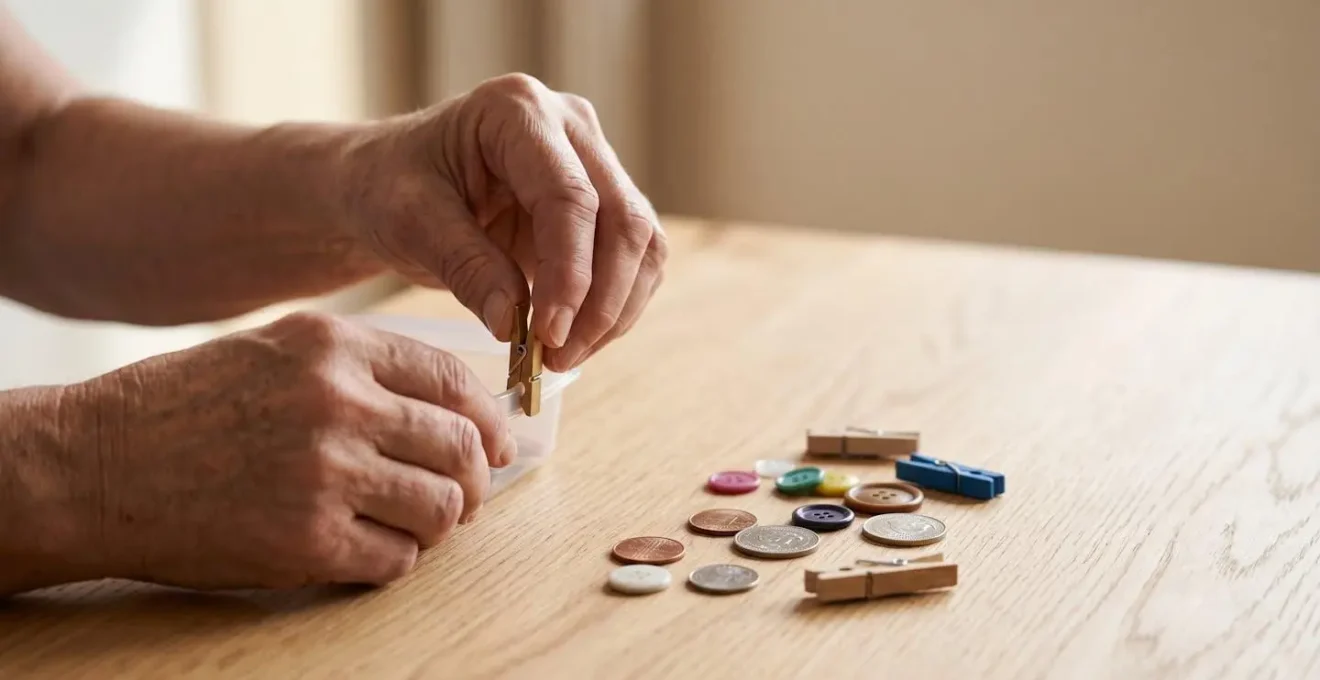
The image above perfectly captures this idea of focused practice. It’s not just about movement; it’s about purpose. As the Saebo Research Team notes, this distinction is critical for driving real change.
Repetitive and meaningful skill-based tasks tend to create stronger neural changes than passive movements alone and are great for motor recovery after stroke.
– Saebo Research Team, Neuroplasticity Explained: The Science of Brain Recovery After Stroke
Every attempt, no matter how small or seemingly unsuccessful, is a building block. It’s the consistent, focused effort on tasks that matter to you that will ultimately pave the new neural highways for your recovery.
How to Turn Making a Cup of Tea into a Motor Skills Exercise
Now that we understand that meaningful, task-based repetition is the key, let’s put it into practice. Forget abstract exercises. Your first and most powerful rehab session of the day can be making your morning cup of tea. This single activity is a symphony of gross and fine motor skills, offering a rich opportunity for task-based neuroplasticity. Instead of seeing it as a challenge to be rushed with your « good » hand, see it as a complete workout for your affected side.
This approach is strongly supported by clinical evidence. A 2022 case study on high-repetition functional task training found that stroke survivors who practiced with everyday objects showed measurable improvements in hand function. The magic ingredient was combining the task with high repetition and sensory awareness—consciously feeling the warmth of the mug or the weight of the kettle. This proves that functional gains are possible even months after a stroke with consistent, creative practice.
To get the most out of it, you need to break the task down. A therapist thinks in terms of grasp patterns, wrist stability, and coordination. Here are some of the specific motor skills you are training when you make a cup of tea:
- Pincer grasp: Using your thumb and index finger to grasp the teabag tag.
- Cylindrical grasp: Wrapping your fingers around the mug handle with controlled pressure.
- Wrist stabilization: Keeping your wrist in a neutral position while lifting the kettle.
- Bilateral coordination: Using your non-affected hand to stabilize the mug while the affected hand pours.
- Fine motor control: Executing a smooth, circular stirring motion.
By viewing this simple routine through a therapeutic lens, it transforms from a chore into a targeted, high-impact recovery session. Every sip becomes a celebration of progress.
Why Passive Stretching Won’t Restore Motor Function on Its Own
A common piece of advice given to stroke survivors is to « stretch the hand » to prevent stiffness. This often involves using the stronger hand to bend back the wrist or uncurl the fingers of the affected hand. This is known as passive range of motion, and while it has its place for maintaining tissue length and reducing spasticity, it is crucial to understand its limitations. Passive stretching does not restore active movement. It is a maintenance tool, not a recovery engine.
Think of it this way: passive movement is like someone else driving your car for you. The car moves, but you’re not learning how to drive. Active movement, where you initiate the action yourself, is you getting behind the wheel. It’s the active attempt that fires up the brain’s rewiring process. As the Saebo Clinical Team puts it, the distinction is fundamental:
Passive exercises are used to prevent stiffness and regain range of motion in muscles, whereas active exercises help strengthen the communication between the brain and body for increased movement.
– Saebo Clinical Team, Stroke Rehab Exercises: Passive Vs. Active
The science backs this up decisively. The signals your brain sends to actively contract a muscle are completely different from the signals involved when that muscle is passively stretched. In fact, a 2024 study using high-density electromyography revealed that only 14.1% ± 13.4 motor unit overlap exists between passive stretch and active contraction in spastic muscles. This tiny overlap shows that passively stretching your hand does very little to teach your brain how to actively use it. So, while stretching can be part of your routine to prepare for activity, it should never be the main event. The focus must always be on encouraging active, intentional movement.
The ‘Good Hand’ Trap: Why Relying on Your Strong Side Slows Recovery
One of the most significant, yet subtle, obstacles to hand recovery is a phenomenon therapists call « learned non-use. » In the weeks and months after a stroke, it’s natural to compensate by using your unaffected, or « good, » hand for everything. It’s faster, easier, and less frustrating. The problem is that the brain is a highly efficient machine. When you consistently neglect your affected hand, the brain learns to ignore it. It essentially quarantines the area of the brain that used to control that hand, making future recovery even harder. This is the ‘good hand’ trap.
To combat this, therapists developed a powerful technique called Constraint-Induced Movement Therapy (CIMT). The core idea is simple but radical: restrict the use of the good hand (often by putting it in a mitt or sling) for several hours a day, forcing the brain to engage with the affected limb. This intensive, task-based practice jump-starts the brain’s neuroplasticity. A comprehensive umbrella review of CIMT studies found it to be highly effective in promoting functional recovery by directly tackling learned non-use.
Modern approaches, known as modified CIMT, are more user-friendly. Instead of all-day restriction, it involves committing to using only your affected hand for specific, timed tasks. For example: for the next 15 minutes, you can only use your affected hand to sort laundry, wipe the table, or organize a drawer. This approach delivers comparable results with better patient compliance and less frustration. The goal is to gently but persistently re-introduce your affected hand into your daily life, reminding your brain that it is still part of the team. It’s about fighting the brain’s tendency to take the easy way out and instead, intentionally choosing the path that leads to recovery.
When is the Brain Most Receptive to Rehab Exercises During the Day?
Timing can be a powerful, and often overlooked, factor in your rehabilitation. Just as an athlete plans their workouts around nutrition and rest, you can optimize your hand therapy by understanding when your brain is most primed for learning. There are two key windows of opportunity to consider: the macro-window of your overall recovery timeline and the micro-windows within your day.
On a macro level, research has identified a critical period for neuroplasticity. A 2021 phase II randomized clinical trial published in PNAS found that 60 to 90 days post-stroke is the optimal period for intensive arm and hand rehabilitation. During this « golden window, » the brain is exceptionally receptive to change. This doesn’t mean recovery is impossible after 90 days—far from it—but it does mean that committing to high-intensity practice during this period can yield significant results.
On a daily, micro level, the best time to practice is when your brain has the most available fuel. This is typically 30-60 minutes after a balanced meal. A healthy meal provides a steady supply of glucose, the brain’s primary energy source. Timing your exercises during this post-meal neuro-boost ensures your brain has the resources it needs to build new connections. It’s also wise to practice when you are mentally fresh and not fatigued. A focused 15-minute session when you feel good is far more valuable than a distracted hour when you’re exhausted. Aligning your efforts with your body’s natural rhythms is a smart strategy to maximize every minute of your practice.
How to Support a Relative on a Virtual Ward Without Burning Out
The role of a caregiver or family member is immensely important, but it’s also fraught with challenges. When supporting a loved one’s recovery at home, it’s easy to fall into the trap of becoming a drill sergeant, constantly nagging them to do their exercises. This approach often leads to frustration for both parties and can result in caregiver burnout. The key is to shift your role from being a manager to being a partner and a cheerleader.
As occupational therapist Kevin Smith wisely points out, celebrating progress is as important as initiating practice. Your role is to help your loved one see the small victories they might miss. This shared joy is a powerful motivator.
It’s not about just nagging someone to do the work; it’s also about helping them recognize the progress their making. Progress is hugely motivating and extremely rewarding when it’s shared.
– Kevin Smith, Occupational Therapist and Certified Hand Therapist, Hand Exercises: An Important Step Toward Stroke Recovery
To avoid burnout, establishing clear communication and boundaries is essential. The survivor needs to feel they have agency, and the caregiver needs to know when to step back. A simple, collaborative system can make all the difference, empowering the survivor to communicate their capacity without feeling guilty and allowing the caregiver to provide support without being overbearing. This creates a sustainable, positive environment for recovery.
Your Action Plan: The Traffic Light Communication System
- Green Signal – ‘I’m feeling good for exercises’: The survivor indicates high energy and readiness for a full exercise session with multiple repetitions. This is the time to try new or more challenging tasks.
- Yellow Signal – ‘I can try, but need help’: The survivor communicates a moderate energy level. They are willing to attempt exercises but may need a modified intensity, more breaks, or additional assistance.
- Red Signal – ‘I’m too tired/in pain, let’s try later’: The survivor clearly expresses the need for rest due to fatigue, pain, or mental exhaustion. This signal must be respected without pressure or guilt.
- Daily Check-In Protocol: Establish a consistent morning check-in to assess energy levels before planning the day’s exercise timing and intensity.
- Shared Goal Documentation: Track progress together using a simple visual chart or journal. This makes progress tangible and provides a focus for celebrating small victories.
The Aging Mistake: Why Walking Isn’t Enough to Keep You Strong
Many people believe that a daily walk is the gold standard for staying healthy as we age. And while walking is fantastic for cardiovascular health, it is not a complete solution for maintaining strength and function—especially after a stroke. This is the « walking mistake »: assuming that one type of general exercise covers all bases. Just as walking alone won’t build the specific muscle strength needed to lift a heavy box, general hand use won’t restore the fine motor dexterity needed to button a shirt.
Stroke recovery requires a progressive and targeted approach. You must move from large, simple movements to small, complex ones. Relying only on gross motor exercises like squeezing a ball is like only ever walking. You build a general foundation, but you never develop the specialized skills needed for real-world tasks. The goal is to progress through different types of exercises that challenge the brain in new ways.
The journey from a basic grasp to functional dexterity is a structured one. Think of it as moving through four distinct stages of training, each using different household objects to achieve a specific neuroplasticity goal. This progression ensures you are constantly challenging your brain to refine its control.
| Exercise Category | Motor Skill Type | Household Object Examples | Progression Strategy | Neuroplasticity Target |
|---|---|---|---|---|
| Gross Motor Hand Exercises | Large muscle groups, basic grasp | Squeezing soft ball, holding water bottle, gripping towel | Increase resistance and duration | General motor cortex activation |
| Transitional Exercises | Moderate precision, grip variation | Picking up large coins, manipulating clothespins, stacking blocks | Reduce object size gradually | Refined motor mapping |
| Fine Motor Hand Exercises | Precise finger control, dexterity | Sorting small buttons, picking up paperclips, threading activities | Increase speed and complexity | Detailed cortical reorganization |
| Functional Integration | Real-world task application | Buttoning shirt, opening envelopes, using keys | Add multi-step sequences | Neural pathway consolidation |
Understanding this progression is crucial. It shows that recovery isn’t just about doing more, but about doing what’s next. You must systematically advance the complexity of your tasks to keep your brain engaged and adapting.
Key takeaways
- Meaningful Repetition is Everything: Your brain rewires itself most effectively when you practice tasks that have a purpose, not just abstract drills.
- Avoid the ‘Good Hand’ Trap: Consciously fight « learned non-use » by creating opportunities for your affected hand to participate in daily life.
- Your Whole Body is the Recovery Engine: Brain health is tied to body health. Good nutrition, timed exercise, and proper rest create the optimal chemical environment for neuroplasticity.
Why Walking 10 Minutes After Meals Is Better Than a Gym Membership for Diabetics
This title might seem out of place in an article about stroke recovery, but the underlying principle is incredibly relevant. The connection between metabolic health and brain health is one of the most exciting frontiers in neuroscience. For a recovering brain, a steady supply of fuel is paramount. Wild swings in blood sugar—common in conditions like diabetes but also affected by general diet—can create an inflammatory environment that hinders the brain’s healing process.
A short, 10-minute walk after a meal is a remarkably effective way to stabilize blood sugar. This simple act helps your muscles use the glucose from your food, preventing a sharp spike and subsequent crash. For a stroke survivor, this metabolic stability translates directly into a more stable energy supply for the brain, creating a better environment for neuroplasticity and healing.
Furthermore, aerobic exercise itself triggers the release of a crucial protein called Brain-Derived Neurotrophic Factor (BDNF). BDNF is like fertilizer for your neurons; it supports their survival, encourages growth, and strengthens the connections between them. As confirmed by researchers, even short bouts of moderate exercise have a powerful effect on this process.
The Connection Between Blood Sugar, BDNF, and Neuroplasticity
Clinical research has firmly established that a healthy diet and regular aerobic exercise create the optimal environment for brain healing by increasing important proteins like BDNF. This connection explains why managing your metabolic health is not separate from your stroke recovery—it’s a core component. By stabilizing blood sugar through post-meal activity, you provide the brain with the steady fuel it needs for the energy-intensive work of rewiring, while also reducing systemic inflammation that can impede progress.
This reveals a holistic truth: your hand exercises are only part of the story. Supporting your brain’s recovery also means managing your diet, getting gentle aerobic exercise, and ensuring you get enough rest. You are building a whole-system environment that is primed for healing.
Now that you understand the principles of task-based practice, the importance of timing, and the role of whole-body health, the next step is to start creatively integrating these ideas into your daily life. Begin today by choosing one simple task and transforming it into your first intentional rehabilitation session.