The main reason people avoid the bowel cancer test is the ‘cringe factor’, but it doesn’t have to be awkward or messy.
- The modern FIT kit is a significant improvement, requiring just one tiny sample with no messy handling.
- Using a simple ‘clean-catch’ technique, which we explain below, prevents mess and ensures a usable sample.
Recommendation: Use the practical, no-nonsense steps in this guide to get the test done cleanly in under five minutes and post it with confidence.
That little brown envelope from the NHS has arrived. For many, the first reaction isn’t relief, but a quiet sense of dread. The bowel cancer screening kit often gets tucked away on a shelf, in a drawer, or sometimes, straight into the bin. As a bowel cancer screening nurse, I’ve heard every reason for not doing it. The overwhelming one? The ‘yuck’ factor. People are worried about mess, embarrassment, and the general unpleasantness of the task. It’s a completely normal feeling, but it’s one that could cost you dearly.
Most guides will tell you *why* it’s important to do the test, citing statistics about early detection. They’ll tell you not to be embarrassed. While true, that advice often misses the point. It doesn’t help you with the practical, logistical challenge of actually collecting a sample when you’re feeling squeamish. We’ve become comfortable with other home health diagnostics, like finger-prick blood tests or Covid swabs, but this one still carries a unique stigma.
This guide is different. We’re going to tackle the cringe factor head-on. We won’t just tell you to do it; we’ll show you *how* to do it cleanly, confidently, and without the drama. Think of this as a direct, practical conversation, just like you’d have with a nurse. We will break down the simple science of the modern test, provide a no-mess collection technique, and demystify the process from start to finish. The goal is to turn an intimidating task into a straightforward, five-minute health check.
This article provides a complete walkthrough, covering everything from the best way to collect your sample to understanding why the test is vital even when you feel perfectly healthy. Read on for a clear, practical plan to get it done.
Summary: Your Practical Guide to the Bowel Cancer Screening Kit
- Why the New FIT Test Is Cleaner and Easier Than the Old Cardboard Ones
- How to Catch Your Sample Without Mess: Practical Tips for the Squeamish
- Why You Need to Test Even If You Have No Symptoms and Normal Poo
- The Toilet Water Mistake That Could Ruin Your Sample
- When to Post Your Sample: Avoiding the Weekend Postal Delay
- NHS Health Check vs Private Full-Body MOT: Is the £300 Cost Justified?
- Why Your Finger-Prick Blood Sample Might Fail Before It Reaches the Lab
- Why Skipping Your NHS Health Check Could Cost You 10 Healthy Years
Why the New FIT Test Is Cleaner and Easier Than the Old Cardboard Ones
Let’s be frank: if your memory of bowel screening involves messy cardboard kits and multiple samples, it’s time for an update. The old Faecal Occult Blood Test (FOBt) was cumbersome and, for many, a major reason for avoidance. The good news is that the NHS now uses the Faecal Immunochemical Test (FIT), a massive leap forward in both science and user-friendliness. This isn’t just a minor tweak; it’s a completely different, cleaner, and simpler process designed to reduce the ‘yuck’ factor significantly.
The key difference is what’s required. The FIT kit needs only one tiny sample from a single bowel movement. The collection tool is a small plastic stick attached to the lid of a sealed sample pot. You simply scrape the surface of the poo with the grooved end of the stick, put it back in the pot, and click it shut. There’s no handling of stool, no spreading it on a card, and far less opportunity for mess. It’s a precise, contained action. This redesign has had a major impact; the latest NHS England data shows a 67.6% uptake rate in 2023-24, partly driven by this easier test.
The science is more sophisticated, too. Unlike the old test, the FIT is specific to human blood, meaning you don’t need to change your diet or stop taking medications before you do it. It’s looking for tiny, invisible traces of blood that could indicate the presence of pre-cancerous polyps. This increased accuracy and simplicity was a core goal of its introduction.
The FIT pilot study suggested that the change in test kit type would not only increase uptake.
– NHS England Bowel Cancer Screening Programme, Bowel cancer screening standards data report 2023-24
Thinking of the test not as a messy chore but as a quick, modern diagnostic check can reframe the experience. It’s designed for minimal contact and maximum hygiene, putting you in control of a clean, simple process.
How to Catch Your Sample Without Mess: Practical Tips for the Squeamish
This is the part that causes the most anxiety, but a little preparation makes it a clean and straightforward process. The goal is to collect a sample that hasn’t touched the water in the toilet bowl. Forget any ideas of fishing around in the toilet; we’re going to create a clean platform to catch the stool. This is the single most important part of the ‘clean-catch’ technique.
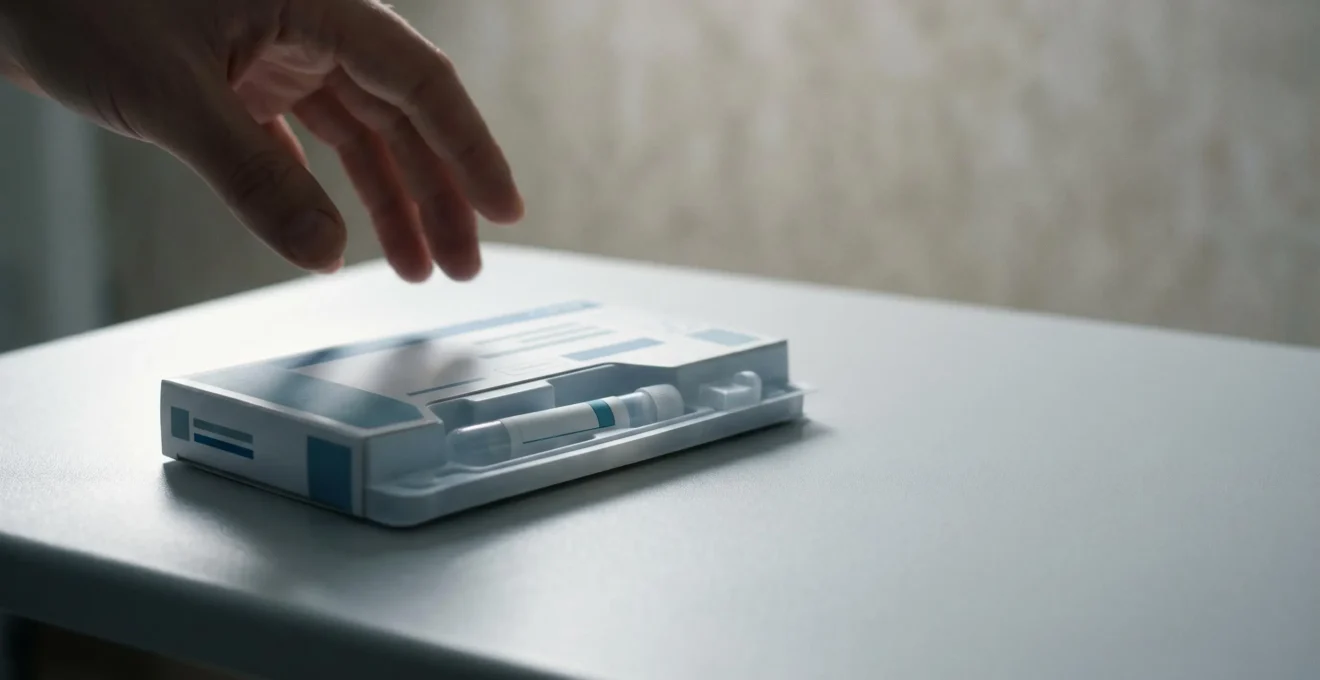
Before you start, get everything you need ready: the opened kit, and your collection ‘platform’. You have a few options for this. You can lay a few scrunched-up sheets of toilet paper on the surface of the water to form a supportive raft. Alternatively, some people find it easier to loosely drape a sheet of cling film across the toilet bowl rim. The key is to create a barrier between the stool and the toilet water. This image below illustrates the kind of precise, careful hand positioning needed for a clean medical sample collection.
With your platform in place, you can have your bowel movement as normal. The stool will land on the paper or cling film, clean and separate from the water. Now you’re ready for the simple collection step. The process is about precision, not mess. Following a clear plan removes the stress and ensures you get a perfect sample first time.
Your Mess-Free FIT Test Plan
- Prepare your space: Before you start, lay out the opened kit on a flat surface (like the closed toilet lid) and wash your hands. Flush the toilet once to ensure the water is clean.
- Create the platform: Place your chosen collection aid (e.g., a thick layer of toilet paper or a sling of cling film) into the toilet bowl to catch the stool.
- Collect the sample: Use the stick attached to the lid of the sample bottle. Scrape the grooved tip along the surface of the stool until the grooves are covered. You only need a tiny amount.
- Seal the bottle: Insert the stick back into the bottle and press the cap down firmly until you hear a click. Do not reopen it. The sample is now securely contained.
- Clean up: Flush the toilet paper and stool away. If you used cling film, gather it and dispose of it in the bin along with any used packaging. Wash your hands thoroughly.
Why You Need to Test Even If You Have No Symptoms and Normal Poo
One of the most dangerous misconceptions about bowel cancer is the belief that « if I felt ill, I’d know. » Many people we send the kit to say they don’t do it because they feel perfectly fine and have no symptoms. This is the ‘no-symptom’ trap. The entire purpose of the screening programme is to find pre-cancerous growths (polyps) or very early-stage cancers long before they cause any symptoms like pain, bleeding, or changes in bowel habits.
When polyps or early cancers bleed, the amount is microscopic and completely invisible to the naked eye. You cannot see it in your poo or on the toilet paper. The FIT test is specifically designed to detect this invisible blood. Finding the cancer at this hidden, asymptomatic stage is the key to a successful outcome. It’s not about diagnosing sickness; it’s about preserving your health. In fact, research shows that the five-year survival rate is 88.5% when bowel cancer is detected at an early symptomatic stage; for screen-detected cancers, the prognosis is often even better.
The screening programme is incredibly effective at this. During the 2023-24 screening year in England, the programme identified 5,320 bowel cancers and, just as importantly, found and removed 35,039 high-risk polyps during follow-up colonoscopies. These polyps are growths that could have turned into cancer if left undetected. Every one of those removals is a potential life saved. If you wait for symptoms to appear, the cancer may be more advanced and harder to treat. The test is your opportunity to catch things at a stage where treatment is often simpler and more effective. A positive result doesn’t mean you have cancer; for most, it means a polyp has been found that can be safely removed to prevent cancer from ever developing.
The Toilet Water Mistake That Could Ruin Your Sample
You’ve overcome the squeamishness and collected your sample. But there’s one common mistake that can make the whole effort worthless: letting the stool touch the toilet water. This isn’t just about hygiene; it’s about the integrity of the test. The FIT test is incredibly sensitive, designed to detect minuscule amounts of human blood. If the stool sample comes into contact with the water in the toilet bowl, two problems arise.
Firstly, the water can dilute the sample. Any traces of blood on the surface of the stool can be washed away or spread so thin that the test can no longer detect them. This can lead to a ‘false negative’ result, giving you false reassurance when there might be a polyp that needs investigating. Secondly, toilet bowl cleaners or limescale removers can contain chemicals that interfere with the test’s antibodies, potentially destroying the very thing the lab is looking for. A contaminated sample is an invalid sample.
This is precisely why the ‘clean-catch’ technique described earlier is so vital. By ensuring the stool lands on a platform of toilet paper or cling film, you create a clean zone that protects the sample’s integrity. It guarantees the lab receives a pure, undiluted specimen that accurately reflects what’s going on inside your body. It’s a simple step that ensures your five minutes of effort aren’t wasted and that you get a reliable result.
When to Post Your Sample: Avoiding the Weekend Postal Delay
Once your sample is sealed in its pot and placed in the prepaid envelope, the final step is to post it. However, timing is everything. A common logistical blind spot is completing the test on a Friday afternoon or over the weekend and popping it in the post box. This can be a critical mistake. The sample contains biological material that can degrade over time, especially if exposed to temperature extremes. For a reliable result, it needs to reach the lab promptly.
A sample posted on a Friday or Saturday might sit in a post box, a sorting office, or a delivery van for two or three days before it even begins its journey to the lab. During this time, it could be exposed to heat in summer or freezing temperatures in winter, both of which can compromise the sample integrity and potentially lead to an inconclusive or failed result. This would mean the inconvenience of having to do the test all over again.
The best practice is to plan your test for early in the week. Aim to collect your sample from Monday to Wednesday morning. This gives it the best chance of being collected and processed through the postal system without sitting idle over the weekend. Before you do the test, check the collection times on your local post box. Try to post the sample on the same day you take it, ideally just before a scheduled collection. Once sealed, store the sample at room temperature, away from direct sunlight or radiators, until you are ready to post it. This simple bit of planning ensures your sample arrives at the lab in the best possible condition.
NHS Health Check vs Private Full-Body MOT: Is the £300 Cost Justified?
The bowel cancer screening programme is just one part of the NHS’s preventative health strategy. For those aged 40-74, the free NHS Health Check is another vital tool. It assesses your risk of developing heart disease, stroke, diabetes, kidney disease, and dementia. This targeted approach contrasts sharply with the growing market for private ‘full-body MOTs’, which can cost hundreds or even thousands of pounds. While the idea of a comprehensive private scan sounds reassuring, it’s crucial to ask if the cost is justified by the evidence.
The NHS Health Check is based on robust, population-wide evidence and NICE-approved protocols. It focuses on conditions where early intervention is proven to be effective. Its value is clear; a 2018 microsimulation study estimates that it prevents 390 premature deaths for every million people aged 40-45 who attend. In contrast, many tests included in private MOTs lack long-term outcome studies to prove they reduce mortality. A major risk with wide-ranging private screening is the detection of ‘incidentalomas’—benign abnormalities that cause significant anxiety and can lead to unnecessary, sometimes risky, follow-up procedures.
The NHS approach is designed to maximise benefit while minimising harm and cost. It provides a targeted, evidence-based assessment of your biggest health risks, free of charge. While a private MOT offers a wider panel of tests, the value of many of those tests for an asymptomatic person is highly debatable among medical experts. The table below, based on an analysis of recent evidence, compares the two approaches.
| Feature | NHS Health Check (Free) | Private Full-Body MOT (£300+) |
|---|---|---|
| Evidence Base | Population-wide evidence, NICE-approved protocols | Variable, often lacking long-term outcome studies |
| Target Conditions | Heart disease, stroke, diabetes, kidney disease, dementia, cancer screening (bowel/breast/cervical) | Wider panel but may include low-yield tests |
| Risk of Incidentalomas | Low – targeted assessment reduces false positives | Higher – extensive imaging can detect benign abnormalities |
| Proven Benefits | Reduces cardiovascular disease, dementia, heart attack, acute kidney problems (2024 research) | Limited evidence of mortality reduction |
| Age Eligibility | 40-74 years, every 5 years | Any age, frequency varies |
| Cost to Patient | £0 | £300-£1,500+ |
For most people, the targeted, proven, and free NHS Health Check offers far greater value than an expensive private scan of questionable benefit. It focuses on what matters and what works.
Why Your Finger-Prick Blood Sample Might Fail Before It Reaches the Lab
While the bowel screening kit involves a stool sample, many other home health tests rely on a finger-prick blood sample. These are often used to check cholesterol, vitamin levels, or hormones. Just like with the FIT test, sample quality is everything, and a surprising number of these samples fail before they even reach the lab. Understanding why can reinforce the importance of following instructions to the letter for any home test.
The most common reasons for failure are haemolysis, clotting, and insufficient volume. Haemolysis occurs when red blood cells burst, often because the finger was squeezed too hard to get the blood out. This contaminates the sample and makes it unreadable. Clotting happens if the blood isn’t mixed with the anticoagulant in the collection tube quickly enough. Finally, if the tube isn’t filled to the required level, the lab simply won’t have enough material to run the test. Each of these issues renders the sample useless, leading to wasted time and the need for a re-test.
This highlights a key principle of home diagnostics: the technology inside the kit is only as good as the sample you provide. This is where the modern FIT test for bowel cancer screening truly excels in its design. The collection method is simpler and more robust, with fewer steps where things can go wrong. There is no complex mixing required, and the sample is stabilised immediately in the sealed pot. The process is designed to be as foolproof as possible, maximising the chance of a successful result on the first try. The efficiency of the FIT process ensures that results can be returned to patients cost-effectively and quickly, ultimately improving patient outcomes.
Key Takeaways
- The screening test is for people with no symptoms. Its purpose is to find hidden, pre-cancerous growths before they cause problems.
- The modern FIT kit is a clean, simple test requiring only one tiny sample—a huge improvement on the old, messy versions.
- Your success depends on two things: a ‘clean-catch’ technique to avoid toilet water and posting the sample early in the week to avoid postal delays.
Why Skipping Your NHS Health Check Could Cost You 10 Healthy Years
Skipping a free NHS Health Check or throwing away your bowel screening kit might seem like a small decision, but the cumulative effect can be profound. These aren’t just bureaucratic exercises; they are powerful tools that can add years of healthy, active life. The evidence is stark. Preventative checks are designed to catch the silent killers of our time—heart disease, diabetes, and cancer—at a stage when they are most treatable.
The long-term benefits are not theoretical. A major 2024 study compared nearly 50,000 health check attendees with non-attendees over an average of nine years. The results were striking: those who attended had a significantly lower risk of dementia, heart attack, acute kidney problems, and liver cirrhosis. By identifying and managing risk factors like high blood pressure or cholesterol early on, these individuals effectively bought themselves more time free from debilitating chronic disease. The ‘ten healthy years’ isn’t a scare tactic; it’s a realistic measure of what’s at stake.
The cost of skipping is not shared equally. It disproportionately affects the most vulnerable, creating a stark gap in health outcomes. This is powerfully illustrated by disparities in bowel cancer screening uptake.
The Case of Screening Inequality
In England’s most deprived areas, bowel screening uptake was only 55.8% in 2023-24, compared to 75.8% in the least deprived areas. NHS modelling shows that if uptake in the most deprived communities rose to just 67%, an extra 160,000 people would be screened annually. This would lead to 3,170 more people being invited for diagnostic follow-ups and an estimated 255 additional cancers being diagnosed and treated each year. This isn’t just a statistic; it represents hundreds of individuals given a chance they would have otherwise missed, demonstrating how skipping a simple check represents a lost opportunity for years of extra, healthy life.
Every screening kit that is completed and returned is a personal step toward a longer, healthier life and a collective step toward a fairer, healthier society. It is one of the most powerful actions you can take for your long-term wellbeing.
That brown envelope contains more than just a plastic tube; it contains an opportunity. An opportunity to stop cancer before it starts. The next step isn’t complicated. Take the kit out of its envelope, re-read the simple steps, and get it done. It’s five minutes of slight awkwardness in exchange for peace of mind and, potentially, years of good health.