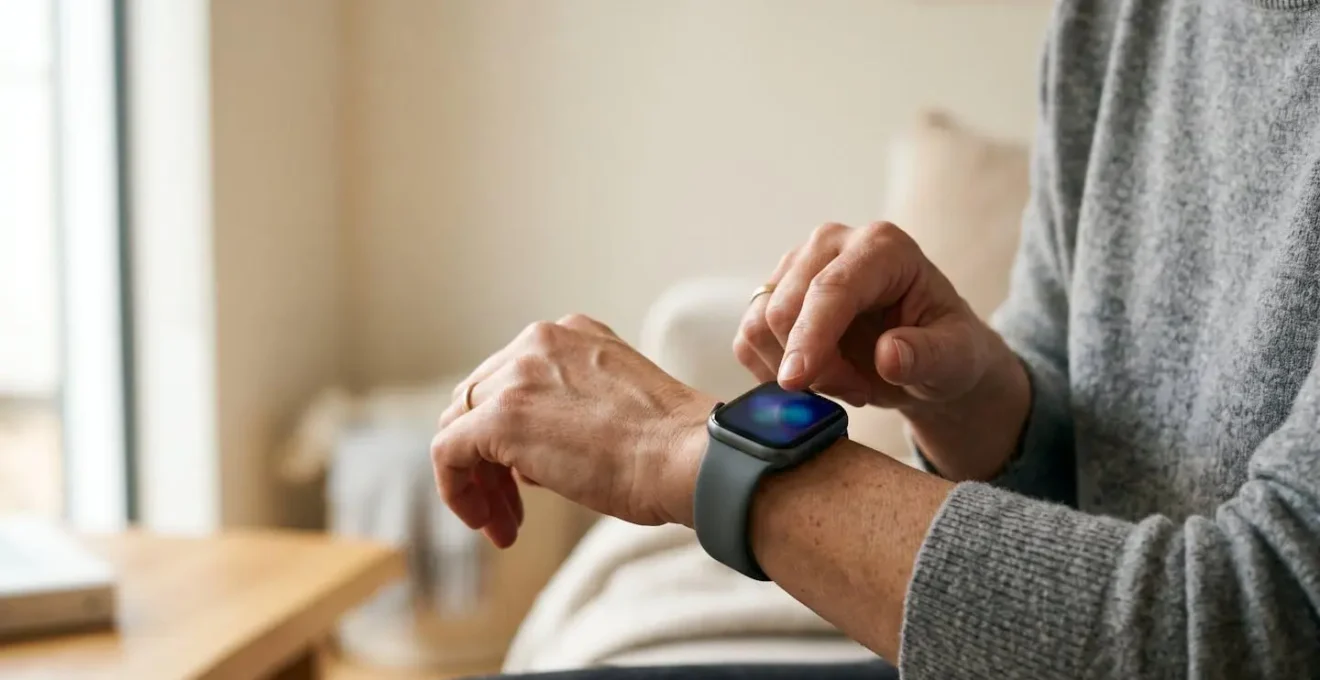
Your wearable isn’t the source of anxiety; our relationship with its data is. The key is shifting from obsessive tracking to skillful interpretation.
- A single alarming data point (like a heart rate spike or low HRV) is usually meaningless « noise. » Meaningful insight comes from consistent, long-term trends.
- Consumer devices are powerful screeners for specific conditions like AFib but are not diagnostic tools for complex events like heart attacks.
Recommendation: Prioritize how you physically feel (interoception) over any single number on your screen. Use your data to ask better questions, not to jump to anxious conclusions.
That sudden buzz on your wrist. Your heart rate has spiked for no apparent reason. Immediately, your mind races: Is something wrong? Am I okay? For millions of us who wear fitness trackers, this scenario is all too familiar. These devices promise a new era of personal health empowerment, yet they often deliver a constant stream of data that can feel more stressful than supportive. We’ve become a generation of amateur data analysts, poring over sleep scores and HRV trends, often without the context to understand what we’re looking at.
The common advice is to « not obsess » and « talk to your doctor, » but this dismisses the very real anxiety these numbers can provoke. It also overlooks the genuine desire for understanding that drives us to track our health in the first place. The problem isn’t the data itself; it’s the lack of a proper framework for interpreting it. We’re taught to chase ‘good’ numbers and fear ‘bad’ ones, without understanding the vast, normal fluctuations of human physiology.
But what if the goal wasn’t to achieve a perfect score? What if, instead, we could adopt a clinical mindset? This guide offers a new perspective, from the viewpoint of a cardiologist fascinated by digital health. It’s not about ignoring your watch; it’s about learning to listen to it correctly. We will transform your health data from a source of anxiety into a tool for genuine self-awareness, teaching you to focus on meaningful trends over fleeting transients.
This article provides a practical framework for making sense of the most common—and most anxiety-inducing—metrics. We will explore how to interpret your HRV, sleep data, and ECG readings with a calm, authoritative perspective, helping you separate the critical signals from the distracting digital noise.
Summary: A Cardiologist’s Framework for Calming Wearable Health Anxiety
- Why Is a High HRV Score Good but a Low One a Sign of Stress?
- How to Fix Your Sleep Cycle Without Obsessing Over Your ‘Sleep Score’
- Smartwatch ECG vs Hospital ECG: Can Your Watch Really Detect a Heart Attack?
- The Tracking Mistake That Is Actually Ruining Your Sleep Quality
- When to Skip the Gym: Using Your Recovery Data to Avoid Injury
- The Security Mistake You Make When Syncing Health Apps to Your GP Record
- The ‘Perfect Patient’ Trap: Why Obsessing Over Wellness Can Increase Anxiety
- Should You Opt Out of NHS Data Sharing? The Pros and Cons for Your Privacy
Why Is a High HRV Score Good but a Low One a Sign of Stress?
Heart Rate Variability (HRV) has become a key metric for many, but its fluctuations are a common source of confusion. In simple terms, HRV measures the variation in time between your heartbeats. A high HRV generally indicates that your autonomic nervous system is balanced and responsive, able to adapt to stress effectively. This is the « rest-and-digest » state. A low HRV suggests your system is in « fight-or-flight » mode, working harder to manage physiological or psychological stress.
However, it’s crucial to understand that HRV is highly individual. A « normal » HRV can range anywhere from below 20 to over 70 milliseconds depending on age, fitness, and genetics. Therefore, comparing your score to others is pointless. The most significant error people make is panicking over a single low reading. As the WHOOP research team notes, « A single low HRV reading is not necessarily a cause for alarm, as your HRV naturally fluctuates from day to day. »
The clinical mindset focuses on trends over transients. A one-day drop after a late night, an intense workout, or a stressful meeting is normal physiological noise. A consistent downward trend over a week or more, however, is a signal worth paying attention to. It could indicate impending illness, overtraining, or chronic stress. Your goal isn’t to have a perfect score every day, but to understand the patterns and behaviors that influence your personal baseline, learning what helps your body recover and what depletes its resources.
How to Fix Your Sleep Cycle Without Obsessing Over Your ‘Sleep Score’
Waking up, reaching for your phone, and immediately checking your « sleep score » is a modern ritual for many. A high score brings a sense of accomplishment; a low one can cast a shadow over the entire day before it even begins. This fixation on quantifying rest has a name: orthosomnia. It describes an unhealthy obsession with achieving perfect sleep data, where the anxiety itself disrupts sleep. This isn’t a niche issue; a 2024 study in Brain Sciences found that the prevalence of orthosomnia among tracker users can be as high as 3% to 14%.
Part of the problem is a misunderstanding of what these devices measure. A 2024 review highlighted that most consumer wearables are not as accurate as clinical polysomnography. They often overestimate total sleep time and struggle to accurately distinguish between light sleep, deep sleep, and simply lying still while awake. This measurement error can create significant anxiety when you see a « bad » score that doesn’t align with how you actually feel.
The solution is to reclaim the first moments of your day for interoception—the practice of sensing your body’s internal state. Before you look at any data, take a moment. How does your body feel? Are you mentally clear or groggy? Refreshed or sore? This subjective feeling is your most important data point. Use your sleep score not as a verdict on your night, but as a hypothesis to test against your physical sensations. If the score is low but you feel great, trust your body over the algorithm. This shifts the power back to you, using the data as a guide rather than a judge.
This practice of checking in with yourself before checking your device is the cornerstone of a healthier relationship with sleep tracking. It allows you to use the data for what it’s good at—spotting patterns in bedtime consistency or the effects of alcohol—without letting it dictate your mood or create a self-fulfilling prophecy of a « bad day » after a « bad score. »
Smartwatch ECG vs Hospital ECG: Can Your Watch Really Detect a Heart Attack?
The single-lead electrocardiogram (ECG or EKG) feature on modern smartwatches is a remarkable piece of technology. Large studies have found it has an over 90% accuracy for detecting the rhythm disturbance known as Atrial Fibrillation (AFib). This makes it an incredibly powerful screening tool, capable of alerting individuals to a common and serious condition they may not have known they had. However, this specific strength has led to a dangerous misconception: that a watch can detect a heart attack.
From a cardiologist’s perspective, it is critical to state this unequivocally: your watch cannot reliably detect a heart attack. The reason lies in the fundamental difference between the technology on your wrist and the equipment in a hospital. An ECG works by measuring the heart’s electrical signals from different angles. Your watch provides just one angle, while a standard hospital ECG provides twelve. This distinction is not trivial; it’s the difference between looking at a house through a keyhole versus walking around and seeing it from all sides.
This table, based on information from sources like a comprehensive guide on wearable ECGs, clarifies the difference in capabilities:
| Feature | Smartwatch Single-Lead ECG | Hospital 12-Lead ECG |
|---|---|---|
| Number of Views | 1 electrical view (like one camera angle) | 12 electrical views (comprehensive multi-angle coverage) |
| Atrial Fibrillation Detection | Excellent (over 90% accuracy) | Gold standard (near 100%) |
| Heart Attack Detection | Cannot reliably detect acute MI electrical changes | Can identify regional ischemia and infarction patterns |
| Abnormal Heart Structure | Cannot reveal structural abnormalities | Can detect chamber enlargement, hypertrophy |
| Ventricular Arrhythmias | May miss or misinterpret from single view | Accurate identification and localization |
| Common False Positive Causes | Poor skin contact, movement artifact, low battery, tremor | Minimal artifact in controlled clinical setting |
| Best Use Case | Screening tool for rhythm monitoring, flagging concerns for physician review | Comprehensive diagnostic assessment and treatment decisions |
Your watch is a screening tool, not a diagnostic one. A « normal » reading on your watch does not rule out a heart problem, and an « inconclusive » reading is often due to motion or poor contact. If you experience symptoms of a heart attack—chest pain, shortness of breath, pain in the arm or jaw—do not check your watch. Seek emergency medical attention immediately.
The Tracking Mistake That Is Actually Ruining Your Sleep Quality
The central paradox of modern wellness tracking is that the very act of monitoring can sometimes undermine the goal. This is most evident with sleep. While the intention is to improve rest, the obsessive pursuit of perfect sleep scores often becomes the primary source of sleep-related anxiety. This isn’t just anecdotal; research covered by TIME magazine revealed that for users aged 18 to 35, nearly 23% reported that sleep apps made them stressed about their sleep. They were spending more time in bed trying to « game » the system, leading to more fragmented, less natural sleep.
This phenomenon was first identified by researchers at Northwestern University, who coined the term « orthosomnia. »
Orthosomnia describes people who become so fixated on achieving optimal sleep scores that the anxiety itself disrupts their sleep.
– Northwestern University Researchers, Original orthosomnia identification study
The single biggest tracking mistake, therefore, is placing more trust in the device’s data than in your own body’s signals. It’s the act of letting a « poor » sleep score dictate that you must be tired, even if you feel rested. It’s the anxiety of seeing less « deep sleep » than the app recommends, which then keeps you awake the following night. This creates a vicious feedback loop where the data doesn’t just reflect your sleep; it actively influences it for the worse.
Breaking this cycle requires a conscious shift in behavior. The goal is to move from being a passive recipient of a « score » to an active participant in your own rest. This involves establishing a consistent wind-down routine—such as reading a book, meditating, or taking a warm bath—that has nothing to do with technology. It means creating a buffer zone of at least 30 minutes before bed and after waking where you do not engage with any data. This allows your natural sleep-wake cycle to function without the performance pressure induced by constant monitoring.
When to Skip the Gym: Using Your Recovery Data to Avoid Injury
For decades, the prevailing fitness mentality was « no pain, no gain. » Pushing through fatigue was seen as a sign of mental toughness. Today, wearable technology offers a more nuanced approach through « recovery » scores. However, many users fall into the trap of viewing a low recovery score as a personal failure, pushing themselves anyway and risking injury or burnout. The clinical mindset reframes this: a low recovery score is not a failing grade, it’s actionable intelligence.
It’s a signal from your autonomic nervous system that it’s currently allocating resources to repair and recovery rather than performance. Ignoring this signal is like driving a car with the oil light on. While a single low score might just be noise, sports-science literature flags a real concern when HRV shows a sustained ≥20% drop from personal 30-day average. This can be an early indicator of overtraining syndrome.
Instead of an all-or-nothing approach, you can use your recovery data to modulate your training intensity. This « training smart » philosophy helps maximize gains while minimizing injury risk. A simple but effective way to apply this is the Red-Yellow-Green framework.
Your Action Plan: The Red-Yellow-Green Recovery Framework
- GREEN (High Recovery/High HRV): Go for it. This is the day to push intensity, attempt a new personal record, or tackle your most challenging workout.
- YELLOW (Medium Recovery/Moderate HRV): Proceed with your planned workout but exercise caution. Stick to the program without adding extra volume or intensity.
- RED (Low Recovery/Low HRV): This is a signal to deload. Swap high-intensity training (like HIIT or heavy lifting) for active recovery such as a brisk walk, gentle yoga, or mobility work.
- CHRONIC RED (3-5 consecutive days below baseline): This is a strong signal of potential overtraining. It’s wise to schedule a full deload week, significantly reducing training volume and prioritizing sleep and nutrition.
- THE VETO RULE: Your body always gets the final say. If your device shows 95% recovery but you feel exhausted, sore, or unwell, your interoceptive sense has veto power. Always trust your body when it conflicts with the device.
This framework transforms your recovery score from a source of guilt into a practical tool for long-term athletic progress and injury prevention. It’s the very definition of working smarter, not just harder.
The Security Mistake You Make When Syncing Health Apps to Your GP Record
In the connected world of digital health, convenience is king. We sync our watch data to third-party nutrition apps, meditation timers, and even directly to our electronic health records, like those held by a GP. Each connection promises a more holistic view of our wellness. However, with every « Allow Access » tap, we make a small but significant trade-off in privacy and security. The biggest mistake is not the initial connection, but the failure to ever review and revoke old permissions.
Think of every app you’ve granted access to as having a digital key to some part of your health data. Over time, we accumulate a large keychain of these permissions, including for apps we tried once and forgot about. These « dormant » apps represent a significant security risk. The company might change its privacy policy, be acquired, or suffer a data breach, exposing your sensitive health information without you even realizing it, because you are no longer an active user of their service.
The principle here is called « permissions creep. » It’s the gradual and often unnoticed accumulation of access rights by multiple third-party services. The solution is proactive digital hygiene. Just as you’d clean out a closet, you should regularly audit your app permissions. Major health platforms make this possible, as noted by Apple’s own documentation: « You can control which third-party apps have access to your health data from the Health app in Sources. » This control is useless if never used.
Set a calendar reminder to perform a quarterly permissions audit. Go to the « Connected Apps » or « Sources » section of your primary health platform (like Apple Health or Google Fit). Review every app. If you haven’t used it in the last 30 days, revoke its access immediately. For the apps you keep, apply the principle of least privilege: ensure they only have access to the specific data types they absolutely need to function. This simple, 10-minute habit dramatically reduces your digital attack surface and ensures you are making conscious, current choices about who gets to see your health data.
Key Takeaways
- Focus on long-term trends, not single, transient data points. A pattern over weeks is a signal; a spike in one day is often just noise.
- Your subjective feeling (interoception) is your most valuable data source. Use your device’s numbers to form a hypothesis, then test it against how you actually feel.
- Use data to inform intelligent decisions (like adjusting workout intensity based on recovery), not to create a pass/fail judgment that fuels anxiety.
The ‘Perfect Patient’ Trap: Why Obsessing Over Wellness Can Increase Anxiety
There’s a personality type that is particularly susceptible to health data anxiety: the high-achiever, the perfectionist, the individual who strives for excellence in all areas of life. When this drive is applied to health metrics, it can create what some clinicians call the « perfect patient » trap. This is the individual who eats perfectly, exercises optimally, and tracks every possible metric, yet lives in a state of heightened anxiety, constantly afraid of a « bad » number that might signal imperfection or illness.
This creates a paradoxical situation where the very tools meant to improve wellness become instruments of psychological distress. As Dr. Rebecca Robbins, a sleep scientist at Brigham and Women’s Hospital, notes, this is a significant risk for a specific type of person.
If you find yourself prone to anxiety and you seek excellence in every part of your life, that’s kind of the perfect storm for orthosomnia.
– Dr. Rebecca Robbins, Mass General Brigham sleep scientist
Falling into this trap means you’ve outsourced your sense of well-being to an external device. Your self-worth becomes tied to the numbers on a screen. The antidote is to actively cultivate a mindset of self-compassion and cognitive reframing. This involves recognizing that your body is not a machine to be optimized, but a complex biological system with natural, daily fluctuations. A « perfect » straight line on a graph is often a sign of a broken sensor, not peak health.
When you see an alarming number, the goal is to pause before reacting. Ask yourself: Is there a benign explanation (caffeine, a stressful email, poor sensor contact)? Is this a single point or a consistent trend? And most importantly: How do I actually feel in my body right now? This conscious interruption of the data-to-anxiety pipeline is the most critical skill for anyone using a wearable device. It allows you to remain the authority on your own well-being, using data as a consultant, not a commander.
Should You Opt Out of NHS Data Sharing? The Pros and Cons for Your Privacy
For those in the UK, the concept of the NHS sharing patient data for research purposes often sparks a debate between public good and personal privacy. While this is a specific national program, it serves as a perfect case study for a question citizens in many countries are facing: what are the trade-offs of large-scale health data sharing? Understanding this helps contextualize the data coming from our own devices.
The argument for sharing is powerful. Anonymized data from millions of patients can help researchers identify disease patterns, test the effectiveness of new treatments, and plan public health services more efficiently. It’s the engine that powers medical breakthroughs. Your data, combined with millions of others, could help find a cure for a future generation. The core promise is that the collective benefit outweighs any individual risk.
The argument against, however, is rooted in valid concerns about privacy, security, and potential for misuse. Even with anonymization, there are fears about « re-identification, » where data could be linked back to an individual. There are also concerns about who gets access. While the goal is academic and clinical research, the involvement of commercial entities can raise red flags. Public health-trained experts like Andrew Telfer have voiced caution about the reliability of data, noting that even professional organizations recommend against using some consumer devices « due to the high incidence of false positives, » which could pollute a national data set if integrated.
There is no single right answer to the « opt-in or opt-out » question. It is a deeply personal decision that depends on your individual risk tolerance and your belief in the system’s ability to protect your data versus its potential to achieve societal good. The key is to make an informed choice rather than a default one. Research the specific safeguards and opt-out mechanisms available in your country’s health system. Understand what data is shared, with whom, and for what purpose. This act of taking ownership of your health data, whether on a national scale or on your own wrist, is the ultimate expression of digital health literacy.