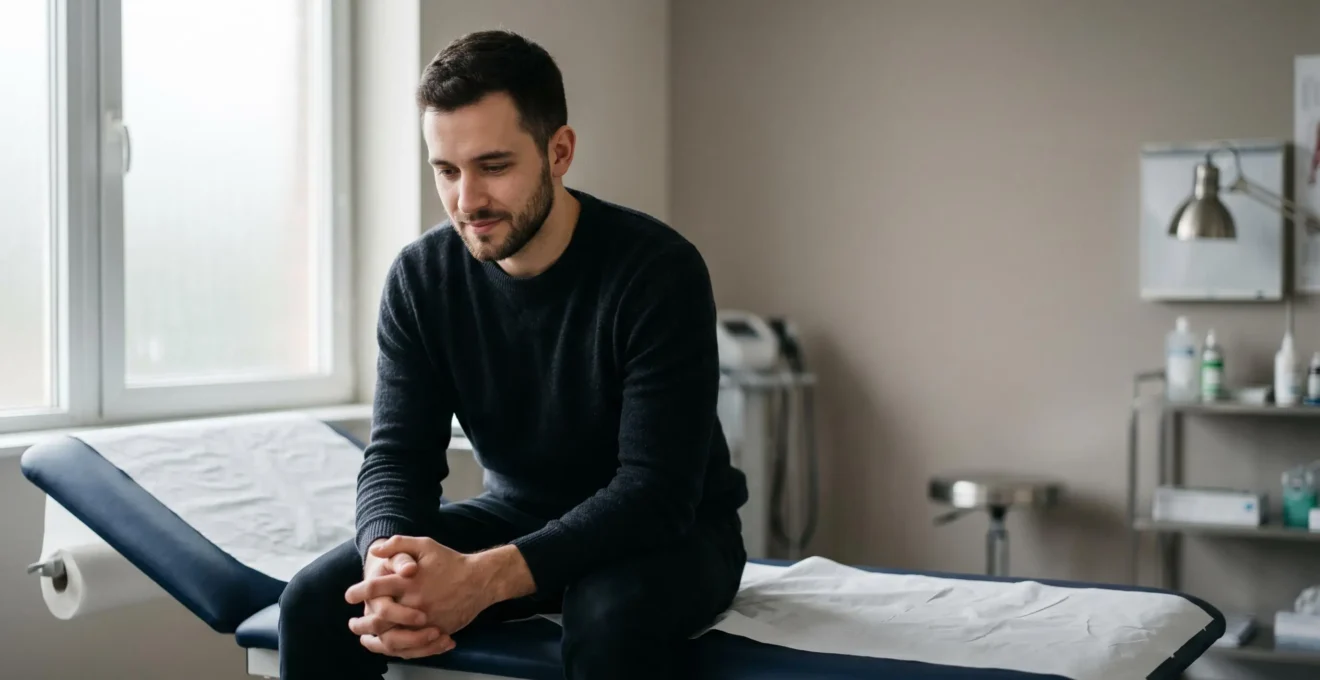
Finding a lump down there is terrifying, and your first instinct is probably to consult Dr. Google, which only makes the panic worse. The real problem isn’t the lump itself, but the cycle of fear and inaction that follows. This guide isn’t just about what to feel for; it’s a straightforward plan from a men’s health specialist to break that cycle, take control of your health with a simple 2-minute check, and know exactly how to talk to a doctor without the guesswork or the awkwardness.
Alright, let’s be direct. You’re here because you felt something… different. A lump, a bump, a change. And your mind immediately jumped to the worst-case scenario. That’s normal. The second thing you probably did was grab your phone and type your symptoms into a search engine. Suddenly, you’re drowning in terrifying medical articles, forums filled with horror stories, and you’re more scared and confused than when you started. You feel frozen, and the thought of talking to anyone about it, let alone a doctor, feels mortifying.
Here’s the thing: most men go through this. They feel a mix of fear, embarrassment, and a toxic dose of « I’ll just ignore it and hope it goes away. » This is the single biggest mistake you can make, not because every lump is a disaster, but because uncertainty is a breeding ground for anxiety. As a urologist, I’ve seen it countless times. The real enemy isn’t what you’ve found; it’s the spiral of panic and inaction fueled by what I call the « Search Engine Mistake. »
This guide is your way out of that spiral. We’re not just going to talk about what could be wrong. We’re going to build a calm, practical plan. I’ll show you how to do a proper self-check, cut through the noise of online misinformation, understand what’s relevant for your age, and even give you a script for how to bring it up with a doctor. This is about taking back control, one step at a time.
Summary: Found a Lump on Your Balls? A Urologist’s No-Panic Guide
- Why Do 60% of Men Delay Seeing a Doctor for Embarrassing Symptoms?
- How to Check Your Testicles in the Shower: A 2-Minute Routine
- Prostate Cancer or Enlarged Prostate: How to Tell the Difference via Symptoms
- The Search Engine Mistake That Convinces Men They Have Cancer
- How to Talk to a Female Doctor About Intimate Male Problems Without Awkwardness
- The Screening Error That Leads to Unnecessary Biopsies and Stress
- Robotic vs Open Surgery: Which Has a Lower Risk of Erectile Dysfunction?
- Prostate Surgery: Is Robotic-Assisted Recovery Really Faster?
Why Do 60% of Men Delay Seeing a Doctor for Embarrassing Symptoms?
Let’s tackle the elephant in the room: why is it so hard to just make the damn appointment? It’s not just you. In fact, research shows that around 65% of men avoid going to the doctor for as long as possible. This isn’t a bug; it’s a feature of how many of us are raised. We’re taught to be tough, to « walk it off, » and that showing concern about our health is a sign of weakness. This creates what I call the « Action Gap »—the chasm between knowing you should do something and actually doing it.
This gap is widened by a few key factors. First, there’s the fear of the verdict. Many men would rather live in anxious uncertainty than risk hearing bad news. It’s a form of denial that feels protective in the short term but is incredibly damaging in the long run. Second, there’s the simple but powerful feeling of embarrassment. The idea of discussing your private parts with a stranger, and potentially being examined, is enough to make many guys retreat.
Cultural scripts about masculinity play a huge role. Studies have shown that men who hold traditional beliefs about self-reliance are far more likely to under-report symptoms, especially to male doctors. There’s a subconscious pressure not to appear weak or vulnerable in front of another man, even a medical professional. This internalised pressure is a massive barrier to getting timely, potentially life-saving care.
How to Check Your Testicles in the Shower: A 2-Minute Routine
Knowledge is power, and the best way to reduce fear is with a calm, consistent routine. Forget panicked prodding in the middle of the night. The best time to do a self-exam is during or after a warm shower when the skin of the scrotum is relaxed. This should be a monthly habit, as routine and boring as brushing your teeth. Think of it as a quick system check, not a frantic search for disaster.
Here’s the simple, 2-minute routine. Don’t overthink it:
- One at a Time: Gently cup one testicle at a time. Use both hands to get a feel for the size and weight. It’s normal for one to be slightly larger or hang lower than the other.
- The Roll: Using your thumb and fingers, gently but firmly roll the testicle between them. You are feeling for any hard lumps, smooth rounded bumps, or significant changes in size, shape, or consistency. The testicle itself should feel firm and smooth, like a hard-boiled egg without the shell.
- Know Your Anatomy: At the back of each testicle is a soft, rope-like tube called the epididymis. This is NOT a lump. It’s supposed to be there. Getting familiar with how it feels is the number one way to avoid a false alarm.
What you’re looking for is a change. A pea-sized, hard lump on the front or side of the testicle, swelling, or a dull ache are things to pay attention to. The goal isn’t to diagnose yourself; it’s simply to gather data. Is there something new or different? If yes, you move to the next step: calling a professional.
Prostate Cancer or Enlarged Prostate: How to Tell the Difference via Symptoms
Lads, let’s get one thing straight. If you’re under 40 and you’ve found a lump, your brain should not be jumping to prostate cancer. The internet has tragically lumped all « men’s health » issues together, but this is a critical distinction that can save you a world of unnecessary anxiety. The issues are completely different, affect different age groups, and have totally different symptoms.
Testicular cancer is, bluntly, a young man’s disease. As the Mayo Clinic Health System states, « Testicular cancer is the most common solid tumor cancer diagnosed in young men. It’s usually diagnosed between the ages of 15 and 45 but can develop at any age. » Statistics confirm this, with data showing the average age at diagnosis is about 33. The primary symptom is a lump or swelling in a testicle. It’s a physical change you can feel.
Prostate issues, on the other hand, are typically an older man’s concern. An enlarged prostate (Benign Prostatic Hyperplasia or BPH) and prostate cancer rarely cause noticeable symptoms in men under 50. When they do, the symptoms are almost always urinary. Things like:
- A weak or slow urinary stream.
- Difficulty starting urination.
- Waking up frequently at night to urinate.
- A feeling that the bladder hasn’t fully emptied.
Notice what’s not on that list? A lump on your testicle. Conflating these two is a classic « Search Engine Mistake. » Your age is one of the most important diagnostic clues, and for the 18-35 crowd, the focus should be squarely on testicular health.
The Search Engine Mistake That Convinces Men They Have Cancer
Let’s call it what it is: Cyberchondria. It’s the digital-age phenomenon where online symptom-checking leads to excessive and unfounded health anxiety. You start with a simple search like « lump on testicle, » and within three clicks, the search engine’s algorithm, designed to show you all possibilities, has led you to a forum about a rare, aggressive cancer. Your heart pounds, your palms sweat, and you’re suddenly convinced you’re dying. You’ve just made the Search Engine Mistake.
This isn’t just a feeling; it’s a well-documented psychological trap. A comprehensive meta-analysis in the Journal of Medical Internet Research found a strong correlation between cyberchondria and health anxiety. The internet provides endless information without context, perspective, or a doctor’s ability to filter out the 99% of irrelevant data. For your search engine, a one-in-a-million disease is just as relevant a result as a common, benign cyst.
The mistake is believing that information equals diagnosis. It doesn’t. Your job isn’t to become a urology expert overnight by reading WebMD. Your job is to notice a change and present that data to an expert who can interpret it. Resisting the urge to self-diagnose online is one of the most important acts of self-care you can perform. Every minute you spend spiraling online is a minute you could have spent booking an appointment to get a real answer.
How to Talk to a Female Doctor About Intimate Male Problems Without Awkwardness
Okay, so you’ve decided to make the appointment. Then you see the doctor’s name, and it’s a woman. A wave of awkwardness washes over you. How are you going to talk about your balls with her? This is a huge mental hurdle for many men, but I’m going to let you in on a professional secret: it might actually be a good thing.
Fascinating research on masculinity and health disclosure found a counter-intuitive pattern. Men who held traditional masculine beliefs—the « strong and silent » types—actually disclosed their symptoms *more* accurately and consistently to female doctors. With male doctors, they tended to downplay their symptoms, perhaps due to a subconscious sense of competition or a fear of appearing ‘less of a man’. A female doctor can neutralize that dynamic, creating a space where you’re just a patient discussing a clinical issue.
Still, knowing that doesn’t make the first few words any easier. The key is to have a script. You need a way to break the ice that feels controlled and direct. Instead of fumbling, you can lead with a clear, factual statement. This isn’t a date; it’s a data transfer. Your goal is to give her the facts so she can do her job.
Your Action Plan: The Awkwardness Script
- Acknowledge the Awkwardness (If it helps): Start with, « This is a bit awkward for me to discuss, but… » It immediately signals the topic and gives you a moment to breathe.
- Use Clinical Language: Saying, « I’d like to talk about a change I’ve noticed in one of my testicles, » sets a professional, medical tone right away.
- Be Direct and Factual: A simple, « I found a lump during a self-check and I want to get it evaluated, » is perfect. It’s direct, non-dramatic, and gives the doctor all the context she needs.
- Remember Her Reality: Remind yourself that this is routine for her. She has seen and examined thousands of patients. What feels intensely personal and embarrassing to you is a standard clinical situation for a doctor.
- Ask for a Chaperone: If the thought of the examination itself is a barrier, you have the right to request a nurse (a chaperone) be present in the room. This is a normal and respected request.
The Screening Error That Leads to Unnecessary Biopsies and Stress
When men finally get to a doctor, their biggest fear is often the « what if, » specifically, « What if it’s cancer and I need a biopsy? » The irony is that the biggest and most common « screening error » isn’t a mistake made by a machine or a doctor—it’s the error of not screening yourself at all and delaying a visit to the GP. That delay is what causes the most stress.
The entire purpose of the monthly self-check is early detection. And when it comes to testicular cancer, early detection is as close to a silver bullet as you can get in medicine. According to research reviewed for the US Preventive Services Task Force, the prognosis is incredibly positive for those who act. One study highlighted that for males who find a lump in its early stages, the 5-year survival rates are greater than 95%.
Let that sink in. A survival rate over 95%. This isn’t a death sentence; it’s one of the most curable forms of cancer when caught early. The « error » is letting fear of the process prevent you from accessing this incredibly optimistic outcome. Worrying about biopsies and further tests is putting the cart miles before the horse. The first step is an ultrasound, which is a simple, non-invasive imaging test using sound waves. It’s painless and can very quickly tell the difference between a solid mass (which needs more attention) and a simple fluid-filled cyst (which is harmless).
By delaying, you give anxiety time to build and, in the worst-case scenario, you give a potential problem time to grow. Acting quickly and getting checked is not about inviting stress; it’s the fastest way to resolve it and get on the path to a near-certain positive outcome if there is an issue.
Key Takeaways
- The vast majority of testicular lumps are not cancerous, but only a doctor with an ultrasound can tell you for sure.
- Your biggest enemy is not the lump; it’s the cycle of panic and inaction caused by « Dr. Google. » A calm, monthly self-check is your best friend.
- Early detection of testicular cancer leads to a 5-year survival rate of over 95%. Acting fast isn’t scary; it’s a power move.
Robotic vs Open Surgery: Which Has a Lower Risk of Erectile Dysfunction?
Now, let’s zoom out and touch on a topic that often gets mixed up in men’s health searches: surgery and its side effects, like erectile dysfunction (ED). It’s crucial to understand that the major surgeries discussed in this context—like a prostatectomy—are for prostate cancer, which, as we’ve established, is an older man’s issue. This is not typically part of the treatment conversation for a young man with a testicular lump.
However, since the fear of ED is so prevalent, let’s clear it up. When it comes to prostate surgery, the debate is often between traditional « open » surgery and robotic-assisted surgery. The primary goal of robotic surgery is precision. The robot’s arms can make finer movements than a human hand, which is critical when operating near the delicate nerve bundles that control erections.
Does this precision translate to a lower risk of ED? The evidence suggests it helps. By allowing the surgeon to see a magnified 3D view and work with more precision, there’s a better chance of sparing those crucial nerves. While no surgery is risk-free and recovery of function can take time, many studies show that patients undergoing robotic surgery often have a quicker return of erectile function compared to open surgery. The risk is not eliminated, but it is often reduced. But again, for our target audience, this is information for the future, not a present concern.
Prostate Surgery: Is Robotic-Assisted Recovery Really Faster?
To round off the topic of surgical concerns, let’s address the question of recovery speed, specifically with robotic-assisted prostate surgery. Again, this is a topic for much later in life, but dispelling the myth and fear is important. The simple answer is: yes, generally, recovery is significantly faster and less painful with robotic surgery compared to traditional open surgery.
Think about the difference. Open prostate surgery involves a large incision in the lower abdomen. It’s a major operation with significant muscle cutting, leading to a longer hospital stay, more pain, a higher risk of infection, and a slower return to normal activities. In contrast, a robotic prostatectomy is performed through a few small keyhole incisions. The surgical instruments and a camera are inserted, and the surgeon controls them from a console.
This minimally invasive approach has clear advantages for recovery:
- Less Blood Loss: The precision and small incisions lead to significantly less bleeding during the operation.
- Shorter Hospital Stay: Patients often go home the next day, compared to several days for open surgery.
- Less Pain: With no large incision, post-operative pain is greatly reduced, meaning less reliance on strong pain medication.
- Quicker Return to Normal: Men are typically back to work and normal, non-strenuous activities within a couple of weeks, rather than the six weeks or more required after open surgery.
So, while the thought of any surgery is daunting, technology has made the process far more manageable and the recovery far quicker than it was a generation ago. It’s another reason why fear of a distant, future treatment should never stop you from taking the simple first step of getting a lump checked today.
Your health is your responsibility, but you don’t have to face it alone or in fear. The single most powerful step you can take right now is to move from passive worrying to active planning. Stop the endless searching and start the process of getting a real answer. Book an appointment with your GP today.