Most health news isn’t ‘fake,’ it’s just misunderstood. The key isn’t spotting sensationalism, but understanding the hidden scientific process behind the headlines.
- Distinguish between unvetted ‘preprints’ that appear on social media and solid, peer-reviewed science that takes months to verify.
- Learn the difference between a scary-sounding ‘relative risk’ (a 50% increase!) and a often negligible ‘absolute risk’ (an increase from 1 in 10,000 to 1.5 in 10,000).
Recommendation: Focus on curating a balanced ‘information diet’ from trusted, slow-moving sources, rather than reacting to every new ‘breakthrough’ or ‘scare’.
One morning, your newsfeed declares that bacon is a one-way ticket to cancer. The next, a different study suggests a daily glass of red wine is the secret to a long life. If you feel like you’re getting scientific whiplash from health headlines, you’re not alone. The constant churn of contradictory advice can make you want to ignore it all, leaving you more confused than informed.
The standard advice is to « check the source » or « look for evidence, » but what does that even mean when the source is a « prestigious medical journal » and the evidence is a dizzying statistic? For most people, these tips are as useful as being told to « fly a plane » by looking at the pilot’s manual. The real issue isn’t just about spotting obvious lies; it’s about understanding how legitimate, well-intentioned science gets twisted, misunderstood, and sensationalized on its journey from the lab to the front page.
The truth is, decoding health news isn’t about becoming a scientist overnight. It’s about becoming a savvy backstage critic of the scientific process. It’s about understanding how a study is built, where the weak points are, and all the places its message can be distorted. This is your guide to getting that backstage pass.
This article will bypass the clichés and take you behind the curtain of science reporting. We’ll explore why real science is so slow, how to spot scam journals that look legitimate, and demystify the statistical tricks that turn tiny risks into terrifying headlines. By the end, you’ll have the tools to build a health news feed that empowers, not panics you.
Summary: A Fact-Checker’s Toolkit for Health Headlines
- Why Does It Take 6 Months for Scientists to Check Each Other’s Work?
- How to Tell If a ‘Medical Journal’ Is Actually a Scam for Money
- Preprint vs Peer-Reviewed: Why You Should Be Wary of ‘Science’ Released on Twitter
- The ‘Bacon Causes Cancer’ Error: Absolute vs Relative Risk Explained
- How to Curate a Health News Feed That Won’t Panic You
- The ‘Miracle Cure’ Error: Why Most ‘Breakthroughs’ Fail in Humans
- My Neighbour vs The Data: Why Personal Stories Are Not Medical Evidence
- Placebo Effect or Real Cure? How to Read Study Results Like a Scientist
Why Does It Take 6 Months for Scientists to Check Each Other’s Work?
In a world of instant news, the pace of science can feel excruciatingly slow. A study is completed, but the results don’t appear for months, sometimes years. This delay isn’t a bug; it’s the central feature of the most critical quality control system in science: peer review. Before a study is published in a reputable journal, it’s sent to a panel of other experts in the same field. These anonymous reviewers act as ruthless critics, poking holes in the methodology, questioning the conclusions, and demanding more evidence. Their job is to ensure the work is sound, original, and significant.
This process is neither quick nor uniform. While fields like medicine often have faster review cycles, research analyzing 3,500 peer review experiences reveals that disciplines in the social sciences and humanities can have much longer timelines. This thorough, often lengthy, debate happens entirely behind the scenes. As researchers Janine Huisman and Jeroen Smits noted in *Scientometrics*, there are even signs that this process has been getting longer over the past few decades.
So when a « new study » suddenly appears in a headline, the first skeptical question to ask is whether it has passed this trial by fire. The painstaking work of peer review is the barrier that separates a scientist’s claim from established scientific knowledge. Sensationalist headlines often source information that has deliberately bypassed this crucial step.
How to Tell If a ‘Medical Journal’ Is Actually a Scam for Money
The phrase « published in a medical journal » is meant to confer authority. But what if the journal itself is a sham? Welcome to the world of « predatory journals, » a dark corner of academic publishing that operates on a pay-to-play model. These outlets exploit the pressure on scientists to publish their work by offering rapid publication for a fee, with little to no genuine peer review. The result is a flood of low-quality, and sometimes nonsensical, research dressed up with the authority of a real scientific paper.
The scale of the problem is staggering. A recent analysis published in The Lancet shows more than 15,000 predatory journals existed as of 2021, with that number likely far higher today. These journals often have professional-looking websites and names designed to mimic legitimate publications, such as « The American Journal of… » or « International Journal of Science. » They aggressively solicit submissions via email, promising a quick and easy path to publication—a huge red flag in the slow and methodical world of real science.
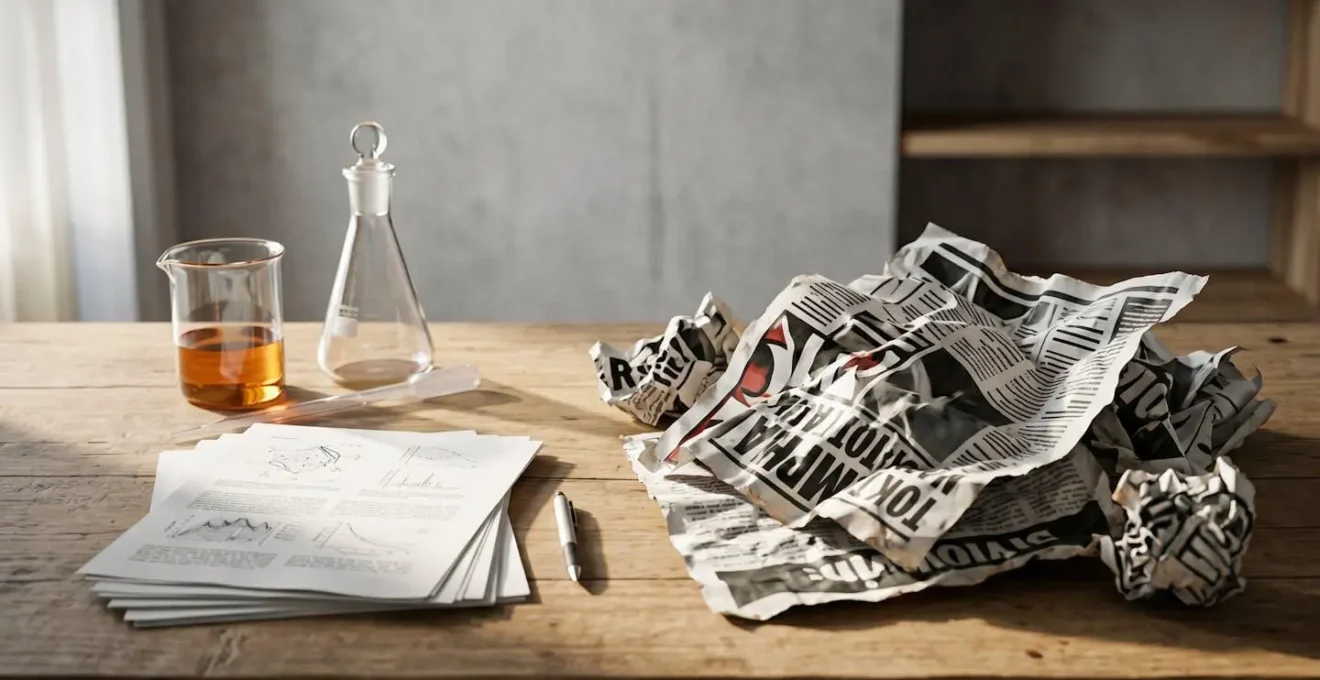
The difference between a legitimate journal and a predatory one can be subtle, but often lies in the production quality and editorial standards, which are invisible to the average reader but telling to an expert eye.
As the image suggests, the tactile signs of quality—or lack thereof—can be a metaphor for the editorial process itself. A legitimate journal invests in rigorous review and careful presentation. A predatory one is a facade, designed to extract cash. This is why simply « checking the source » isn’t enough; you have to be able to check if the source itself is trustworthy.
Preprint vs Peer-Reviewed: Why You Should Be Wary of ‘Science’ Released on Twitter
If peer review is the slow, sturdy foundation of science, then preprints are the architectural sketches—interesting, but not ready to live in. A preprint is a scientific manuscript that is uploaded to a public server *before* it has undergone peer review. It’s the scientific equivalent of a public rough draft, shared to get early feedback from colleagues. Services like bioRxiv and medRxiv became household names during the COVID-19 pandemic, providing a vital way for scientists to share findings rapidly in a global crisis.
However, this speed comes at a cost. The pandemic saw an explosion of unvetted information, with more than 3,000 articles on COVID-19 uploaded as preprints in the early stages alone. Many journalists, and the public, treated these preliminary findings as gospel. The problem is that many of these initial findings are later found to be flawed or are significantly changed during peer review. When a preprint goes viral on Twitter, it’s often the most sensational—and least nuanced—version of the story that spreads.
This creates an information gap that misinformation thrives in. Research from the team behind the Hoaxy platform, a tool for tracking misinformation, revealed a critical weakness in our information ecosystem. They found a characteristic lag of approximately 13 hours between the spread of misinformation and the fact-checks that try to correct it. In the fast-paced world of social media, 13 hours is an eternity. By the time a correction is issued, the initial, flawed preprint has already cemented itself in the public consciousness.
The ‘Bacon Causes Cancer’ Error: Absolute vs Relative Risk Explained
Perhaps the most common way legitimate science is twisted into a terrifying headline is through the deliberate confusion of two very different concepts: absolute risk and relative risk. Understanding the difference is your single most powerful tool for cutting through health hype. Relative risk tells you how much a certain behavior multiplies your risk. Absolute risk tells you your actual odds of the event happening.
A classic example is the infamous « processed meat causes cancer » story. Headlines warned that eating processed meat daily increases your risk of colorectal cancer by 18%. That sounds terrifying! But that 18% is a relative risk. The average person’s lifetime absolute risk for this cancer is about 5%. An 18% increase on that 5% risk raises your absolute risk to about 6%. Suddenly, the danger seems far less dramatic. It’s an increased risk, yes, but it’s not the death sentence the headline implies.
An even starker example comes from the reporting on the Fukushima nuclear disaster. Headlines screamed about a finding that represented a 70% increase in relative cancer risk for some residents. This was based on data showing the rate of thyroid cancer in an exposed group of girls was 1.25%, compared to a baseline rate of 0.75% in an unexposed group. While 1.25% is technically about 70% higher than 0.75%, the absolute risk only increased by a minuscule 0.50%. This isn’t lying, but it’s a form of statistical malpractice that preys on public fear.
How to Curate a Health News Feed That Won’t Panic You
Given the flood of sensationalism, preprints, and statistical sleight-of-hand, it’s no wonder that people feel overwhelmed. The goal isn’t to retreat from health news entirely, but to actively curate a healthier information diet. This is more than a trivial matter of media consumption; according to a Pew Research Center study, 70 percent of Americans report that health information they find online influences their medical decisions. Building a better feed is a critical act of self-care.
This means consciously choosing sources that prioritize context over clicks. Major public health organizations (like the WHO or the NIH in the US), university-affiliated news offices, and science-focused publications are good places to start. They tend to report on science more slowly and with more nuance. It also means changing your own behavior: instead of sharing a shocking headline, share the thoughtful article that explains the ‘why’ behind it. So, how do you put a filter on the firehose, especially with visual media like YouTube?
Your Action Plan for Vetting Online Health Information
- Check the date: In science, older isn’t always wiser. Videos older than a year may be outdated. Sort your searches by date to find the most current information.
- Verify the source: If no source is cited, or you’ve never heard of the organization, the information may not be authoritative. Look for content from reputable organizations like national health institutes.
- Look for balanced content: Real medicine has risks and benefits. If a video presents a treatment with no mention of side effects or alternative options, it’s likely biased or a sales pitch.
- Beware red flag language: Phrases like ‘miracle cure,’ ‘secret remedy,’ or ‘detox’ are massive warning signs. If it sounds too good to be true, it almost certainly is.
By applying these filters, you move from being a passive consumer of alarming headlines to an active curator of a balanced and reliable stream of information. This proactive approach is the best defense against health-related anxiety and misinformation.
The ‘Miracle Cure’ Error: Why Most ‘Breakthroughs’ Fail in Humans
Every week, it seems, there’s a new « breakthrough » that promises to cure Alzheimer’s, reverse aging, or end cancer. These headlines are often based on real, but very early-stage, laboratory research—studies done on cells in a petri dish or in mice. While these are essential first steps, the leap from a lab bench to a human patient is a treacherous one, a journey so fraught with failure that scientists have a name for it: the « Valley of Death. »
The statistics are humbling. According to the American Psychological Association, pharmaceutical development data shows that over 90% of promising findings in labs die in this valley and never become an approved treatment for humans. A drug that shrinks a tumor in a mouse may be toxic to a human liver. A compound that works on isolated cells may not even reach its target inside a complex human body. This massive failure rate is a normal, expected part of the scientific process.
The problem arises when these preliminary findings are reported without this crucial context. As William Klein, PhD, an expert in health misinformation, states, « Health misinformation also takes hold because not everyone has a firm enough understanding that the scientific process takes time to establish evidence. » A headline announcing a « miracle cure » based on a mouse study isn’t just premature; it’s profoundly misleading and can create false hope for patients and their families.
Key Takeaways
- Peer review is a slow, deliberate quality filter; ‘science’ released on Twitter (preprints) has skipped this crucial step.
- Always question risk statistics. A huge ‘relative risk’ increase (e.g., 50%) might be an insignificant ‘absolute risk’ in reality (e.g., your chance going from 1 in 10,000 to 1.5 in 10,000).
- Most ‘breakthroughs’ in labs fail in the « Valley of Death. » Be skeptical of ‘miracle cure’ headlines until large-scale human trials confirm the results.
My Neighbour vs The Data: Why Personal Stories Are Not Medical Evidence
Your neighbor swears by a celery juice diet that cured their arthritis. A viral video shows a patient’s miraculous recovery after trying an unproven supplement. These stories are emotionally powerful, compelling, and incredibly persuasive. They are also, from a scientific perspective, completely useless as evidence. An individual’s experience is an anecdote, not data.
Our brains are wired to respond to narratives, not spreadsheets. A personal story connects with us on an emotional level that a statistical table never can. This is a primary reason why misinformation spreads so effectively. In fact, research with 853 participants found that false headlines were shared 32.4% more often than true ones, partly because false narratives are often simpler and more emotionally resonant. The problem with anecdotes is that they are a sample size of one. We have no idea what other factors were at play. Did your neighbor also start exercising? Was the recovery a coincidence? Was it the placebo effect?
Science relies on large, controlled studies precisely to iron out these confounding variables and isolate the true effect of a treatment. As William Klein, PhD, observes, « We know narratives make a difference, but we don’t yet understand all the nuances. How are narrative videos affecting health decision-making and behavior? » While a personal story can be a source of inspiration or a starting point for a conversation with a doctor, it should never be mistaken for medical proof.
Placebo Effect or Real Cure? How to Read Study Results Like a Scientist
So, how do you put it all together and read study results like a scientist? It boils down to adopting a mindset of healthy skepticism and asking a few key questions. When you look at a study, you’re not just looking for a cure; you’re looking for rigor. The gold standard is the randomized controlled trial (RCT), where one group gets the treatment and another gets a placebo, without anyone knowing who got what. This design helps untangle the real effect of the drug from the powerful placebo effect—the phenomenon where patients feel better simply because they believe they are receiving treatment.
A scientist reads the « methods » section before the « results. » They want to know: How big was the study? Was there a control group? Were the results statistically significant, or could they have happened by chance? This critical posture is built into the scientific system itself. While imperfect, the process of peer review is constantly being refined. For example, the State of Peer Review 2024 survey reveals that 84% of respondents felt they had not experienced bias, an improvement from previous years, showing a system striving to be more objective.
Ultimately, being scientifically literate means becoming comfortable with uncertainty and complexity. It’s about understanding that science is a process, not a book of facts. Findings are updated, advice changes, and what we believe today may be refined tomorrow. As William Klein, PhD, wisely puts it, « We need to help people understand that when there are changes in the scientific findings, those findings are not problematic but the way science works. »
Start building your critical toolkit today. The next time you see a sensational health headline, don’t just read it or share it—interrogate it. Ask the tough questions, demand the context, and reward the sources that treat you like an intelligent reader, not a click.